Furniture
Research
Mark Golding and Paul Shutler have worked to create these
pages for use by those interested in the development of furniture
design and manufacture in the 19th and 20th centuries in Great
Britain. Paul Shutler is a freelance furniture historian and
researcher, and can be contacted via
Paul
Shutler
FOR SALE &
WANTED
We are seeking good examples
of Furniture made by Lamb of Manchester, Gillows, Holland
& Sons, Howard & Sons, Collinson and Lock, Morris
& Company, Heal's of London, Jackson & Graham, The
Guild of Handicraft, William Watt, Liberty & Co.
A DIRECTORY OF 19TH & 20TH
CENTURY BRITISH FURNITURE MAKERS AND RETAILERS
We are attempting build a reasonably comprehensive directory
of 19th and 20th century British furniture makers and retailers.
Paul
Shutler, a freelance furniture researcher and
historian is the leading light behind this project, and we
could not have come this far without referring to publications
by both THE
FURNITURE HISTORY SOCIETY and the REGIONAL
FURNITURE SOCIETY.
If you can add any information to this directory (makers,
retailers, dates, biographies, web links, images of marks/stamps/labels
and other information) we would be extremely grateful, and
we will gladly acknowledge your support and help. Also, please
keep up informed of any mistakes we make! Email theartsandcraftshome@gmail.com
Below the directory you will find a series of biographical
essays of several of the major 19th Century British furniture
companies. If you wish to publish your essay, we will post
and credit your research.
A
ALEXANDER, H & AG & CO
Steam Chair Factory, Rotherglen, Glasgow, 1900's
ANGUS, WM & CO
Cabinet Makers, London, c1900
ARROWSMITH, A J
19th Century furniture makers, 80 New Bond Street, London.
B
BAKER OAKFORDBRIDGE
19th Century cabinet-maker, Oakford, Devon.
BARKER J & CO LTD
Antique dealer, furniture maker, Kensington High Street, London.
BARRETT W
19th and 20th century furniture makers, Newland Street, High
Wycombe, Buckinghamshire.
BARLOW & CO
19th and 20th century furniture makers, Oakridge Road, High
Wycombe, Buckinghamshire.
BARLTETT WM & SON LTD
19th and 20th century furniture makers, Grafton Street, High
Wycombe, Buckinghamshire.
BATEMAN, WILLIAM
BAVERSTOCK, H
Folding Chairs, Hackney, London 1890's
BAYLEY & BLEW
19th Century furniture makers, Cockspur Street, London.
BELL & COUPLAND
19th Century furniture maker, Preston, Lancashire.
BERTRAM & SON
19th Century furniture makers, 100 Dean Street, London.
BETTRIDGE & CO
19th century cabinet makers, Birmingham, exhibited at the
1862 International Exhibition.
BIRCH WILLIAM
19th century cabinet makers and chair makers, Leigh Street,
High Wycombe.
BIRCH & ALPE LTD
19th and 20th century furniture makers, Kitchener Road, High
Wycombe, Buckinghamshire.
BLAIN A & SON
19th Century furniture makers, Liverpool.
BLYTH & SONS
Furniture Makers, Finsbury, London 1870-80
I’m a descendant of David Blyth who started the firm
in the early 1800’s – it was later carried on by
his son James, and eventually closed in the early 1900’s.
The firm’s primary address was 4-7 Chiswell Street in
London. At one point they held warrants as suppliers to the
Admiralty and the King of Siam (or at least that’s what
their letterhead said…). They apparently opened a 2nd
location in Liverpool for a period of time. Information courtesy
of Jennifer Wiber (Toronto Canada)
BRETT, ARTHUR
19th and 20th Century furniture makers, Norwich.
BRIDGES
Early 19th Century chair makers.
BROOKS, HENRY & CO
BROWN, R A
20th Century box makers.
BRUNSWICK M
19th century cabinet makers, London, exhibited at the 1862
International Exhibition.
C
CALDECOTT
19th Century cabinet makers, London, exhibited at the 1851
Crystal Palace Exhibition.
CALLAGHAN, V
19th Century maker of astronomy chairs, 28a New Bond Street,
London.
CASTLE & ABBOTT
19th and 20th century furniture makers, Nutfield Lane, High
Wycombe, Buckinghamshire.
CASTLE BROS
19th and 20th century furniture makers, Upper Desborough Park
Road, High Wycombe, Buckinghamshire.
CHAPMAN BROTHERS
20th Century mirror and frame makers, 241, Kings Road, Chelsea,
London.
CLARK J
19th and 20th century furniture makers, Abercrombie Avenue,
High Wycombe, Buckinghamshire.
COALBROOKDALE
19th Century cast iron founders, Coalbrookdale, Shropshire.
COLLIER & PLUNKNETT
19th Century furniture makers, Warwick, Warwickshire.
COLLINSON & LOCK
19th Century cabinet makers, St Bride Street, London.
COOKES
19th century cabinet makers and carvers, Warwick, exhibited
at the 1851 Crystal Palace Exhibition.
COX & SON LTD
19th and 20th century furniture makers, Oxford Road, High
Wycombe, Buckinghamshire.
COX & YEMAN
19th Century billiard equipment makers, London
CRACE
19th Century cabinet makers, Wigmore Street, London
CRACE AND MAZOROZ
19th Century cabinet makers, Wigmore Street, London
D
DOVESTONE, BIRD & HULL
19th Century cabinet makers, Manchester
DOVESTONE, DAVEY, HULL & CO
19th Century cabinet makers, Manchester
DRUCE & CO
19th Century furniture makers and antique dealers, Baker Street,
Portman Square, London.
DYER & WATTS
19th century cabinet makers, London, exhibited at the 1862
International Exhibition.
E
EDWARDS & ROBERTS
19th and 20th Century cabinet makers, 21 Wardour Street, London.
ELLIS WALTER E
19th and 20th century furniture makers, West End Road, High
Wycombe, Buckinghamshire.
ELLMORE, WT & SON
Cane Furniture, Leicester, 1890's
ENGLAND
19th century cabinet makers, Leeds, exhibited at the 1851
Crystal Palace Exhibition.
EVANS J & SON
19th and 20th century furniture makers, Abercrombie Avenue,
High Wycombe, Buckinghamshire.
EVANS BROS
19th and 20th century furniture makers, Kitchener Road, High
Wycombe, Buckinghamshire.
F
FENTLEMAN & SONS
20th century cabinet makers, Dock Street, Aldgate, London.
FILMER & SONS
19th century cabinet makers, London, exhibited at the 1862
International Exhibition.
FORSYTH J
19th century cabinet makers, London, exhibited at the 1862
International Exhibition.
FORWARD & DONELLY LTD
19th and 20th century furniture makers, Temple End, High Wycombe,
Buckinghamshire.
FOX T
19th century cabinet makers, London, exhibited at the 1851
Crystal Palace Exhibition.
FREEMAN
19th Century cabinet makers, 10 London Street, Norwich.
FRY & CO
19th century cabinet makers, Dublin, exhibited at the 1862
International Exhibition.
FURNITURE INDUSTRIES LTD
19th and 20th century furniture makers, London Road, High
Wycombe, Buckinghamshire.
FURLONG, JOHN
19th Century cabinet makers, 136-8, Powis Street, Woolwich,
London.
G
GARNETT, R
19th Century cabinet makers, Warrington, Cheshire
GEORGE & SONS
19th century cabinet makers, London, exhibited at the 1862
International Exhibition.
GILLOW & CO
19th and 20th Century cabinet makers and antique dealers,
Lancaster, Lancashire and London.
GILLOWS
19th and 20th Century cabinet makers, Lancaster, Lancashire.
GLENISTER THOMAS LTD
19th and 20th century furniture makers, Temple Works, High
Wycombe, Buckinghamshire.
GOMME E
19th and 20th century furniture makers, Leigh Street, High
Wycombe, Buckinghamshire.
GOODALL, LAMB & HEIGHWAY
Cabinet makers and Upholsterers, Manchester. Late 19th early
20th century cabinet makers, Manchester, Lancashire.
GOODEARL B & SONS
19th and 20th century furniture makers, Desborough Road, High
Wycombe, Buckinghamshire.
GOODEARL HY & SONS
19th and 20th century furniture makers, West End Road, High
Wycombe, Buckinghamshire.
GOODEARL BROS LTD
19th and 20th century furniture makers, Mendy Street, High
Wycombe, Buckinghamshire.
GRANVILLE & CO LTD
19th and 20th century furniture makers, Unity Works, Ogilvie
Road, High Wycombe, Buckinghamshire.
GREGORY & CO.
19th Century cabinet makers, Regent Street, London.
GRIEW J & CO
19th century cabinet makers and carver, Chatham Place, Hackney,
London
GRIFFITHS, ROY
20th Century cabinet maker, Wisbech.
GRUBB
19th century cabinet makers, Banbury, exhibited at the 1851
Crystal Palace Exhibition.
GUILD OF HANDICRAFT
19th Century furniture makers, Chipping Camden, Gloucestershire
GUTTA PERCHA COMPANY
19th century cabinet makers, London, exhibited at the 1851
Crystal Palace Exhibition.
H
HAMFORD BROTHERS
19th Century cabinet makers, upholsterers and trunk-makers,
9 Cross Street, Ryde, Isle of Wight
HAMILTON
20th Century garden furniture maker, London.
HAMPTON & SONS LTD
19th and 20th century cabinet makers and antique dealers,
Pall Mall east, London.
HANDS & SON
19th and 20th century furniture makers, 36 Dashwood Avenue,
High Wycombe, Buckinghamshire.
HARRISON & SON
19th Century cabinet makers, Burnley and Blackburn, Lancashire.
HAYBALL
19th century cabinet makers, Sheffield, exhibited at the 1851
Crystal Palace Exhibition.
HEAL & SON
19th and 20th Century cabinet makers, Tottenham Court Road,
London.
HEALY W H LTD
19th and 20th century furniture makers, London Road, High
Wycombe, Buckinghamshire.
HENRY, JS
Cabinet Makers, 287-9 Old Street, London, 1890's
HERRMANN, H.
Steamers, Dod Street, Limehouse, London, 1890's
HINKS, HENRY
Early 19th Century cabinet makers, Gosport.
HINDLEY & SONS
19th Century cabinet makers, 64 Oxford Street, London.
HOLLAND & SONS
19th Century cabinet makers, Royal Warrant Holders, Marylebone
Road, London.
HOWARD & SONS
19th Century cabinet and chair makers, Royal Warrant Holders,
parquet floor manufacturers, decorators, upholsterers and
antique dealers, Berners Street, London.
HOWLAND R & SONS LTD
19th and 20th century furniture makers, Denmark Street, High
Wycombe, Buckinghamshire.
HOWLAND R J & CO LTD
19th and 20th century furniture makers, Oakmead, High Wycombe,
Buckinghamshire.
HUNTER W & J
19th century cabinet makers, London, exhibited at the 1851
Crystal Palace Exhibition.
HUTTON, WILLIAM
19th Century chair maker, Barnstable, Devon.
I
INGLEDEW
19th century cabinet makers, London, exhibited at the 1862
International Exhibition.
J
JACKSON & GRAHAM
19th Century cabinet makers, 37 - 38 Oxford Street, London.
JAMAR, S
19th Century cabinet makers, Gerard Street, London.
JAMES, ROBERT
19th Century cabinet makers, 35 Broad Street, Bristol.
JANCOVSKY
19th century cabinet makers, York, exhibited at the 1851 Crystal
Palace Exhibition.
JENKS & WOOD
20th Century cabinet makers.
JENNENS & BETTRIDGE
19th Century papier mache furniture makers, Birmingham, West
Midlands.
JEWELL, S & H
19th Century cabinet makers, 131-2 High Holborn, London.
JOHNSTONE & JEANES
19th century cabinet makers, London, exhibited at the 1862
International Exhibition.
JONES
19th century cabinet makers, Dublin , exhibited at the 1851
Crystal Palace Exhibition.
JOUBERT
19th century cabinet makers, London, exhibited at the 1862
International Exhibition.
JOYNSON HOLLAND & CO
19th and 20th century furniture makers, Abercrombie Avenue,
High Wycombe, Buckinghamshire.
K
KAUFMAN & CO
Cabinet Makers, Weaste, nr Manchester 1890's
KENDALL T H
19th century cabinet makers, Warwick, exhibited at the 1862
International Exhibition.
KENDELL, J & CO
19th Century chair makers, Maney.
KNIGHT T
19th century cabinet makers, Bath, exhibited at the 1862 International
Exhibition.
L
LAMB J OF MANCHESTER
19th Century cabinet makers, Manchester, Lancashire.
LANGLEY, G
19th Century cabinet makers, 226 Whitechapel, London.
LAWES, T & CO
Cabinet maskers, Upholsterers, Timber and Feather Merchants,
65 City Road, London, 1880's
LAZARUS L & SONS
19th and 20th century cabinet makers, Lorenco road, Tottenham
London.
LECAND
19th century cabinet makers, London, exhibited at the 1851
Crystal Palace Exhibition.
LEUCHARS
19th Century box makers, 38 Piccadilly, London.
LENYGON & MORANT
20th Century chair makers, decorators and antique dealers,
48 South Audley Street, London.
LEVEIN
19th century cabinet makers, London, exhibited at the 1851
Crystal Palace Exhibition.
LIBERTY & CO
19th and 20th Century Furniture retailers and decorators,
Regent Street, London.
LINLEY, DAVID
20th Century cabinet makers, Pimlico Road, London.
LITCHFIELD & RADCLIFFE
19th century cabinet makers, London, exhibited at the 1862
International Exhibition.
LUND, THOMAS
19th Century box makers, Cornhill, London
M
MADDOX, GEORGE
Upholsterer, 21 Baker Street, London, 1860-85, Manufactory
21 Blandford Mews
MAKEPEACE, JOHN
20th and 21st Century cabinet makers, Dorset.
MANUEL, JOHN & SONS
19th Century cabinet makers, Sheffield, Yorkshire.
MAPLE & CO
19th and 20th Century cabinet makers, antique dealers and
decorators, Tottenham Court Road, London.
MARSH & JONES
19th Century cabinet makers, Leeds, Yorkshire.
MARSH, JONES & CRIBB (LATE KENDELL & CO)
19th Century cabinet makers, Leeds, Yorkshire.
MAYER & BEKENN
19th Century cabinet makers, St. Mary's Square, Birmingham.
McCREA
19th century cabinet makers, Halifax, exhibited at the 1851
Crystal Palace Exhibition.
MEIN, J
19th Century cabinet makers, Roxbourgh, Kelso.
MELLIER & CO
19th Century cabinet makers, Margaret Street, London.
MILNE W & J
19th Century box makers, 126 Princess Street, Edinburgh.
MINTER, G
19th Century chair makers, 33 Gerard Street, London.
MOORE & HUNTON
Cabinet Makers and Upholsterers, 59-64 Worship Street and
107-112 Paul Street, London 1880's
MORANT
19th century cabinet makers, London, exhibited at the 1851
Crystal Palace Exhibition.
MORRIS & CO
19th and 20th century cabinet makers and decorators, Oxford
Street, London
N
NEEDHAM, WF
Bamboo Furniture Manufacturer, Birmingham, 1880's
NICOLL
19th century cabinet makers, London, exhibited at the 1851
Crystal Palace Exhibition.
NORMAN & STACEY
19th and 20th century cabinet makers and retailers, Tottenham
Court Road, London.
NORTH, BENJAMIN & SON
Chair makers, High Wycombe
NOSOTTI Charles
19th century cabinet makers and frame makers, London, exhibited
at the 1862 International Exhibition. Charles Nossotti, 398,399
Oxford St, originated in Milan and listed as a carver/gilder,
recorded in Westminster London in 1831, known as the 'looking
glass manufactory'. Collaborating with Howard and Sons for
the 1862 Exhibition.
P
PALMER
19th century cabinet makers, Bath, exhibited at the 1851 Crystal
Palace Exhibition.
POOLE & MACGILLIVRAY
19th century cabinet makers, London, exhibited at the 1862
International Exhibition.
PRATT & PRINCE
19th century cabinet makers, Bradford, Yorkshire.
PRIEST, W
19th Century cabinet makers, 1 and 2 Tudor Street, Blackfriars,
London.
R
RADLEY E
19th century cabinet makers, London, exhibited at the 1862
International Exhibition.
REID, JOHN
19th Century cabinet makers, 47 Meadow Road, Leeds, Yorkshire.
RICHARDSON, W
19th Century cabinet makers, 20 Mary Street, Dublin.
RIDGE J
19th century cabinet makers, 91 Church Street, Croydon.
ROBERTSON & SON
Cabinet maker, Alnwick, 1880's
ROGERS & DEAR
19th century cabinet makers, London, exhibited at the 1851
Crystal Palace Exhibition.
ROSSITER, R
19th Century cabinet makers, South Moulton, Devon.
S
SCOTT J & T
19th century cabinet makers, Edinburgh, exhibited at the 1862
International Exhibition.
SEDDON, T & G
19th Century cabinet makers, Aldersgate Street, London.
SEDLEY
19th century cabinet makers, London, exhibited at the 1862
International Exhibition.
SHAPLAND & PETTER.
19th and 20th Century cabinet makers, Barnstable, Devon.
SHARD J & CO
19th and 20th century cabinet makers and snooker cue makers,
Hendon, Nort London.
SHOOLBRED, JAMES
19th Century cabinet makers, Tottenham Court Road, London.
SIMPOLES
19th Century cabinet makers, Manchester, Lancashire.
SIMSON, GEORGE
19th Century cabinet maker, Churchyard, London.
SKERRITT, H
19th Century cabinet and mangle maker, Old Church Yard, Manchester.
SLATER, EDWARD
19th Century chair makers, 2 Queens Buildings, Brompton, London.
SMEE WILLIAM A & S
19th century cabinet makers, upholsterers, carpet and bedding
warehouse, 6 Finsbury Road, London and Little Moorfields,
London.
SNELL
19th century cabinet makers, London, exhibited at the 1851
Crystal Palace Exhibition.
SOPWITH AND CO LTD
19th and early 20th, Newcastle upon Tyne.
SPENCER, J
19th Century chair maker.
SPILLMAN & CO
19th Century cabinet makers, St Martins Lane, London.
STEVENS J
19th century cabinet makers, Taunton, exhibited at the 1851
Crystal Palace Exhibition.
STOREY & TRIGGS
19th century cabinet makers and antique dealers, Queen Victoria
Street, London.
STRAHAN & CO
19th century cabinet makers, Dublin, exhibited at the 1862
International Exhibition.
T
TAYLOR, JOHN
19th Century cabinet makers, Edinburgh.
TILLMAN, WILLIAM
20th Century cabinet makers, London.
TRAPNELL & SON
19th century cabinet makers, Bristol, exhibited at the 1851
Crystal Palace Exhibition.
TROLLOPE & SONS
19th Century cabinet makers, Parliament Street, London.
TROTTER, WILLIAM
19th Century cabinet makers, Edinburgh.
TWEEDY T H
19th century cabinet makers, Newcastle on Tyne, exhibited
at the 1862 International Exhibition.
V
VAUGHAN & SON
19th and 20th century furniture makers, 330c, Old Street,
London.
W
WARING J
19th and 20th Century cabinet makers, (1835 - 1903) Lancaster,
Lancashire, showroom in Oxford Circus, London, merged with
Gillow in 1903.
WARING AND GILLOW
20th Century cabinet makers (1903 - 1986)
WATT, WILLIAM
19th Century cabinet makers, London.
WERTHEIMER S
19th century cabinet makers, London, exhibited at the 1862
International Exhibition.
WHITE J P
19th and 20th century fine and garden furniture makers, Pyghtle
Works, Bedford.
WHYNTALL, THOMAS
19th Century cabinet makers, Cripplegate, London.
WHYTOCK & CO
19th century cabinet makers, Edinburgh, exhibited at the 1862
International Exhibition.
WHYTOCK & REID
19th and 20th Century cabinet makers, Edinburgh.
WILKINSON C
19th Century cabinet makers, Ludgate Hill, London
WINTER, JAMES & SONS
19th Century cabinet makers, 101 Wardour Street, London.
WOOD & HEMMONS
19th and 20th century cabinet makers and antique dealers,
Redcliffe Street, Bristol.
WRIGHT & MANSFIELD
19th Century cabinet makers, London.
WYLIE & LOCHHEAD
19th Century cabinet makers, Glasgow.
Y
YOUNG, ALEXANDER
19th and 20th Century cabinet makers, North Shields.
A HISTORY OF HOLLAND AND SONS
During the 1850's Holland and Sons undertook 300 separate
Government Commissions as well as their other work, and designed
in almost every style fashionable. They retained Pugin's designs,
and adapted them whilst furnishing Mr. Speaker's House in
the 1850s and for gothic rooms elsewhere.
Holland and Sons employed some of the top designers at this
time, including Professor Gottfried Semper, Alfred Lormier,
Henry Whitaker, T.R. Macquoid, J.R. Collings, G.E. Street
and Bruce Talbert, who were used on better commissions, and
greatly helped Holland to keep its top position.
It is fascinating to see how many styles Holland and Sons'
architects and designers could produce between them, and with
such confidence and perfection, from the grand gothic of New
Palace Westminster, the pale timbers of Osborne House, the
French Exhibition styles, and the Thornton Commission in Sidmouth,
Grecian after Professor Semper (Plates XI and XII) Jacobean
(Plate IX), the monumental, and the aesthetic with cabinets
by Talbert.
To complement these styles many fine timbers were used like
Oak, Walnut, Satinwood, Ebony, Hungarian Ash, Tulipwood and
Maple, with marquetry and bronzed or decorated, to name some;
often different marbles were used to complement the wood or
surroundings. Some of the rich surfaces were enhanced by mounts
in ormolu, inlay, marquetry and carving; sometimes whole suites
of furniture for every style of room were made, including
curtains, chair covers, carpets and mirrors, with chairs and
dining room furniture made of walnut, oak, mahogany and birch.
All the display cases for the South Kensington Museum were
supplied to specific designs.
Holland and Sons, as did other London cabinet makers in this
era, continued the tradition that English carcase work and
construction was easily the finest in the world; whilst mahogany
had lost favour as a veneer, it was used extensively for drawer
linings in top furniture, and as a secondary wood whenever
appropriate; consequently the veneers and marquetry remain
so stable that even the surface can still be undisturbed allowing
patina to accumulate; joints, tenons and dovetails stay tight,
due to perfect cabinetwork, seasoned timber and practical
design.
It should be noted that much of Hollands' production was
of a lesser, bread and butter nature (Plate IX is a well designed
example) and even bedroom and servants furniture were supplied.
Also services of a day to day nature were on offer to favoured
clients, including the unblocking of drains!
Grand funerals were a feature of Victorian life as was mourning,
and Holland arranged Wellington's State Funeral at a cost
in excess of £1,000.
Whilst our fine Holland and Sons exhibits date from the 1850s
and 1860s, arguably their zenith, the firm enjoyed a long
and successful span from 1815 to 1968.
The details below come from London Directories of the times,
and give the dates and addresses of the business.
1815 Taprell and Holland, 25 Gt. Pultenay St.
1817 Taprell and Holland, 25 Gt. Pultenay St, and 19 Marylebone
Street.
1826 Taprell and Holland, 19 Marylebone Street.
1832 Taprell and Holland, 19 Marylebone St, and 6 Silver
St. (works).
1843 Holland and Sons, 19 Marylebone St, and 38 Broad St.
(works).
1850 Holland and Sons, 19 Marylebone St, Ranelagh Works,
Lower Belgrave St.
1852 Holland and Sons, Ranelagh Works, 19 Marylebone St,
and 23 Mount St.
(Holland and Son merged with Thomas Dowbiggin and Sons at
23 Mount St. giving up their Marylebone premises.)
1874 Holland and Sons, 23 Mount St, 4 Ebury St and 44 Gillingham
St.
(1890 Morris & Co bought Ebury St Works)
1895 Thomas Dowbiggin ceased trading.
1904 Holland and Sons "Furniture Makers, Cabinetmakers,
Upholsters, Surveyors, House and Estate Agents, 9 Mount St,
and Ranelagh Works, Chapter St.
1968 Closed down 7th October.
Almost complete records were preserved and are kept at the
Archive of Art and Design, London.
HOLLAND AND SONS - ROYAL COMMISSIONS.
The Daybooks contain extensive supplies made to 5 Royal residences
- Osborne House, Sandringham, Balmoral, Windsor Castle and,
when Prince Edward Albert was given Marlborough House as his
official residence, Holland and Sons refurnished it throughout.
Holland and Sons arranged the funeral of Prince Albert with
the Royal household.
Thomas Dowbiggin of Mount Street (later Holland and Sons)
supplied the State Throne with dais and canopy in 1837 for
Victoria's Coronation, and it is in the Buckingham Palace
Throne Room today.
In 1877 furniture was supplied to the Emperor of Austria
for his steam yacht.
For further reading try: "Royal Victorian Furniture Maker"
by Edward Joy: Burlington Magazine - Nov. 1969 pp. 677-687.
EXHIBITIONS.
Holland and Sons in order to remain pre-eminent were actively
showing specially designed furniture in exhibitions at home
and abroad. These included the following recorded items:
1851 - The Great Exhibition, Crystal Palace, London.
A Royal cabinet of massive proportions in the renaissance
style, centred round an integral British marble fireplace,
and made of British woods, and minerals.
1855 -The International Exhibition, Paris.
A renaissance collectors' cabinet of ebony, the door inset
with porcelain plaques, having gilt metal mounts, and gallery,
supported on a stand with 4 Grecian bronzed legs. Designed
by Professor Gottfried Semper, and purchased by the South
Kensington museum in 1860.
1862 - International Exhibition, London.
A Louis XVI style cabinet in thuyawood with marquetry panels
and ormolu mounts to the central door, flanked by bookshelves.
Also a profusely inlaid and marquetry silverwood loo table
with guilloche pattern, and hilt mounts.
1867 - Universal Exhibition, Paris.
An art cabinet or dressoir of oak inlaid with exotic wood
and gilt brass strap hinges, the whole surmounted by pinnacles
and designed by Bruce Talbert.
1872 - Annual International Exhibition.
An inlaid and ebony cabinet with dead game inlay and medallions
of ivory.
1878 - Paris Universal Exhibition.
A satinwood cabinet inlaid in the Adam revival taste.
This information is by courtesy of The Country Seat.
A HISTORY OF GILLOWS OF LANCASTER
and WARING & GILLOW
1731-1986
A Company History
The firm of Gillows of Lancaster can be traced back to Robert
Gillow (1704-72) in 1730, having served an apprenticeship
as a joiner. During the 1730's he began to exploit the lucrative
West Indies trade exporting mahogany furniture and importing
rum and sugar. Following his death in 1772, the business was
continued by his two sons, Richard (1734-1811) and Robert
(1745-93). In 1764 a London branch of Gillows was established
at 176 Oxford Road, now Oxford Street, by Thomas Gillow and
William Taylor. The firm rapidly established a reputation
for supplying high quality furniture to the richest families
in the country.
During the final years of the 19th century the company ran
into financial difficulty and from 1897 began a loose financial
arrangement with Waring of Liverpool, an arrangement legally
ratified by the establishment of Waring and Gillow in 1903.
Warings of Liverpool were founded by John Waring, who arrived
in the city from Belfast in 1835 and established a wholesale
cabinet making business. He was succeeded by his son Samuel
James Waring who rapidly expanded the business during the
1880's, furnishing hotels and public buildings throughout
Europe. He also founded Waning-White Building Company which
built the Liverpool Corn Exchange, Selfridge's department
store and the Ritz Hotel.
Gillows had established a reputation for the outfitting of
luxury yachts and liners, including the Royal Yacht "Victoria
and Albert", liners "Lusitania", "Heliopolis"
and "Cairo", RMS "Queen Mary" (1934) and
"Queen Elizabeth" (1946) for Cunard. During the
First World War the Lancaster factory was turned over to war
production, making ammunition chests for the Navy and propellers
for De Havilland DH9 aircraft and during World War Two produced
parts for gliders and the Mosquito aircraft, while kit-bags,
tents and camouflage nets were made by the upholstery department.
However, the business of the firm began to decline and the
Lancaster workshops closed on 31 March 1962. In 1980 Waring
and Gillow joined with the cabinet making firm Maple &
Co, to become Maple, Waring and Gillow, subsequently part
of Allied Maples Group Ltd, which included Allied Carpets.
Making numbers and stamps -
The making numbers were stamped on the pieces of furniture
when they did not form part of a special order. The letter
L placed before the number indicates that the piece was manufactured
at the Lancaster factory.
The stamp GILLOWS LANCASTER first appeared on furniture between
1780 and 1790. By the middle of the 19th Century GILLOW is
found stamped on pieces in 2.5mm letters. By the end of the
19th Century GILLOW & Co is often found, lightly impressed
in letters 3mm high. Waring and Gillow instituted a thin stamped
brass name plate, a practice that was continued up to the
1950's.
Marks are generally found on the top edges of drawers, on
the underside of lids or table tops, on the right hand back
leg of early chairs and under the front edge of the seat of
later chairs. Very often the pencilled signature of the craftsman
making the piece can be found on the underside of a drawer.
Waring and Gillow records.
A HISTORY OF COLLINSON &
LOCK
'Art Furnishers', founded with the partnership of F.G. Collinson
and G.J. Lock, former employees of Jackson & Graham. Designers
employed by the firm included T.E. Collcutt, the architect
of their premises; E.W. Godwin, who was paid a retainer to
produce exclusive designs for the company from 1872 to 1874,
H.W. Batley and Stephen Webb. They made furniture for the
new Law Courts to designs by G.E. Street, along with Gillows
and Holland & Sons, and began decoration of the Savoy
Theatre in 1881. Jackson & Graham was taken over in 1885,
at the time when the firm had moved to Oxford Street and begun
to focus on expensive commissions for grandiose London houses.
The change of direction was not a success, and the firm was
taken over by Gillows in 1897.
The firm of Collinson & Lock was established in London
in the third quarter of the 19th century and quickly achieved
both commercial success and a leading position in the field
of design. In 1871 the firm issued an impressive illustrated
catalogue of 'Artistic Furniture', with plates by J. Moyr
Smith, assistant to Christopher Dresser, and in 1873 was trading
from extensive newly built premises in St Bride Street. The
firm continued to produce very high quality items of furniture
and soon began to experiment with new materials and designs,
becoming especially renowned for their distinctive combinations
of rosewood and ivory and their intricate Italianate arabesques,
traditional figures and scrolling foliage. This form of decoration
clearly points toward the involvement of Stephen Webb, Collinson
& Locks chief designer who was later appointed Professor
of Sculpture at the Royal College of Art.
Information from 19th Century Design by Michael Whiteway.
A BRIEF HISTORY OF HOWARD &
SONS, BERNER STREET, LONDON
By Paul A. Shutler
In 1820 John Howard started trading at 24 Lemon St, London,
as a 'Cabinet Manufacturer'. He was to stay there for nine
years until he moved premises to 27 Great Alie St. and then
later in 1832 he was to move the small distance to 34 Great
Alie St where he would stay and open an upholstery workshop/showroom
at 36 Red lion St until 1845 (the Red Lion premises were only
used for one year).
It wasn't until 1848 after a short period of non-trading
that the company was to take on part of the address more familiar
with the company. In 1848 John Howard and Sons started trading
at 22 Berners St as 'Cabinet Maker, Upholsterer and Decorator'.
In 1853 John Howard expanded the business into 26 Berners
St.
From 1861-89 and 1865-68 there were workshops at Tottenham
St, Charlotte Mews and Fitzroy Sq respectively. After Crystal
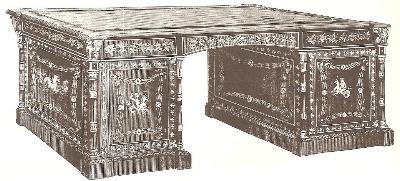
Palace 1862 saw the first big break for the company when they
won a prize at only the second Exhibition they attended, the
prize was for suite of library furniture, of which fig 1 forms
a part.
Fig 1, 1862 International Exhibition, Art
Journal engraving
In1865 the young George Howard patented a method for veneering
walls with a wooden veneer, instead of wall paper or paint,
This was to evolve into flooring which prompted George to
take out a patent in 1867 on the improved production of parquet
flooring. From 1865 Howard and Sons were listed as 'Upholsterers,
Cabinet Makers and Parquet Flooring Manufacturers by Steam
Power'. A further four patents were subsequently taken out
on the manufacture and fixing of parquetry to floors and ceilings
in November 1879, July 1880 and July and December 1883.
In 1866 George Howard Patented something that would secure
his family's company a place in history, he patented the 'Elastic
Seat'. His patent totally re-designed the inside workings
of traditional upholstery, creating the superior seat, is
what they are now widely known only for.
1872 saw the company's most significant move when they settled
at the address 25, 26 and 27 Berners St, this was only after
they consolidated their workshops in 1869 to the Cleveland
Works in Cleveland St. These addresses were to remain unchanged
until 1935. Howard and sons were to exhibit and win prizes
from this address at the 1878 International Exhibition, the
1894 Antwerp Exhibition and win 1 silver and 2 gold medals
at the 1900 Paris Exhibition.
Howard and Sons became a limited company in 1899, and advertised
in 1920 as manufacturers of 'Parquet Floors by Electric Power',
and were awarded the first of their royal warrants in 1901.
In 1935 Howard and Sons traded from 31 Old Burlington St
where they produced mainly upholstered furniture and then
ceased trading in 1947. This was the end of the cabinet making
side of the firm under the name 'Howard', as after seven years
of silence in 1954 the well established house decorators Lenygon
and Morant Ltd advertised as being 'Makers of Howard Chairs
and Sofas' from their address at 48 South Audley St, this
lasted until 1959 when the name was once again silent. Chairs
that follow George Howard's patent are today available at
30 Lyme St from 'Howard Chairs Ltd'.
Howard and Sons would make identification easier by marking
their work. Cabinet work would either have paper labels, stamps
on later pieces Ivorine labels. Upholstered furniture would
have either a name and/or number stamp on the inside of the
back foot, a paper label on the hessian or a name stamp on
the castor cup or wheel. The content i.e. address on the stamp
varies depending on the date of the piece.
Instant identification however can be determined by their
favoured use of a variation of turning on the front legs,
generally speaking the more squashed this turning the later
the piece, fig 2 and fig 3, a standard square tapered leg
was also used, fig 4.
fig1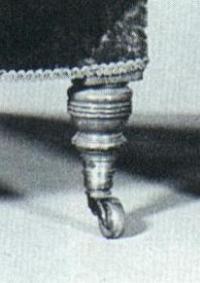 fig2
fig2 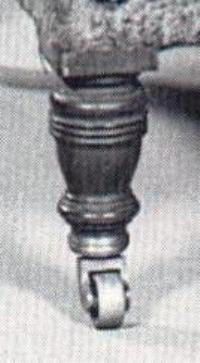 fig3
fig3 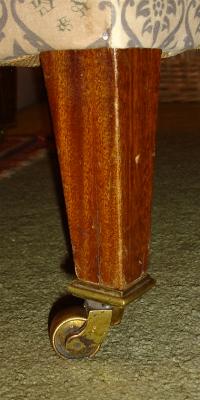
Some upholstered pieces retain their initialled (fig 5) calico
covering, either this or a floral calico (fig 6) were used
on all upholstered pieces and were usually covered using a
well fitted loose cover also made by Howard and Sons. Both
the initialled and floral covers came in a limited range of
colours.
fig 5  fig 6
fig 6 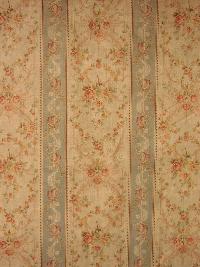
LIBERTY & COMPANY
A History of Liberty Furniture
by Barbara Morris
There is a considerable variety in the furniture and styles
of interior decoration produced by Liberty's between 1880
and 1910. On 13 March 1900, Arthur Lasenby Liberty gave a
lecture on English Furniture to the Society of Arts. He began
his talk with a brief historical survey in which he stated
that our finest period of furniture began with the accession
of James I, declined during the first half of the 19th century
until the `Gothic revival brought us back to first principles
of construction and directness of design'. He went on to stress
the importance of comfort -- `Better a Windsor chair with
comfort than a chaise a la Louis Quinze which makes one's
back ache' - also stating that 'Utility, which means fitness,
is in itself beauty if rightly understood'. Certainly, apart
from some of the Oriental imports, most Liberty furniture
was well made and soundly- constructed, but not all of it
can he said to measure up to his other dictum of `no unnecessary
decoration'.
'Anglo-Oriental' furniture by Liberty & Company
As Godwin had stated in 1876 (The Architect, 23 December),
for the first year there was no 'decent furniture', but early
in 1880 Liberty's decided to departmentalize their stock,
furniture being sold in the `D' Department. The catalogue
of oriental goods, Eastern Art Manufactures and Decorative
Objects, published in 1881, included a section labeled 'Department
D', with carved wooden pieces from China and Japan, together
with cane chairs, stools and wastepaper baskets from North
Africa. Apart from these imported foods, small items of bamboo
furniture such as overmantels and shelves are described as
'Anglo-Oriental'. The catalogue also offered to have 'Special
designs made to order drawings post free'. This Anglo-Oriental
furniture was made by a French craftsman, Monsieur Ursin Fortier,
originally - a basket maker, who had premises in Soho. Liberty's
placed their first order with M. Fortier in 1881 and he continued
to work exclusively for Liberty's throughout the 1880's, supplying
a variety bamboo furniture including chairs and tables, cabinets
and writing desks inset with panels of Japanese lacquer, leather
paper or 'old fold' matting, and smaller items such as hanging
shelves, easels and cakestands. In the 1890s the bamboo furniture
was called 'Anglo-Indian' or `Chinese' and the rank widened
to include chairs and settees upholstered in 'Djijim Kelims',
As well as being available in the Regent Street shop, some
of the early Liberty furniture was shown in the galleries
of the Royal School of Needlework in South Kensington. In
1883 The Cabinet Maker and Art Furnisher (vol. III, 1883,
p. 182) included Liberty's among its list of' high class firms
selling furniture, stating that:
'…some of the cane chairs, carved cabinets, screens
and flower stands shown by this enterprising firm are marvels
of art and cheapness. Messrs. Liberty are evidently educating
their Oriental producers as to the wants of our market and
the result is that an English home can he almost entirely
furnished with Eastern goods'.
Such furniture, however, would have had a limited appeal,
and it became obvious that a wider range should be available.
Accordingly, in 1883 Liberty's set up a Furnishing and Decoration
Studio under the direction of Leonard Wyburd, a painter who
exhibited at the Royal Academy from 1888 to 1905, describing
himself as `Painter and Architect'. Wyburd retired from Liberty's
in 1903 but continued to work independently describing himself,
in an advertisement in the Studio Year Book of 1906, as `Designer
and expert adviser in Decorations and Furniture - over 20
years with Liberty & Co.'
A wide variety of furniture in a number of different styles
was to be produced by, or for, the Liberty Furniture and Decoration
Studio under his direction, but Wyburd's own specialty was
`Moorish' furniture and decoration, or Egyptian based designs.
The Thebes stools
Among the earliest items of furniture that can be fully documented
were two stools, based on ancient Egyptian prototypes, both
called the 'Thebes' and registered in 1884. One, a four-legged
stool, usually made in walnut but also in mahogany, with turning
on the lower legs and a leather seat attached to the frame
with thonging, has the Patent Office Design registration No.
16673. It was hardly an original design, as the ancient Egyptian
prototype had already inspired a number of artists and designers
earlier in the century. A drawing of a similar Egyptian stool
by J.G. Grace, dated 1853, is now in the RIBA, and Ford Madox
Brown designed a comparable Egyptian style chair for Holman
Hunt in 1857. A number of other artists, including Christopher
Dresser and E.W. Godwin, produced drawings of ancient Egyptian
furniture in the 1870s. It is tempting to suggest that Godwin,
who was then in charge of Liberty's Costume Studio, may have
had a hand in the origin of this 'Thebes' stool, for a drawing
of the prototype occurs on a page of museum studies in a Godwin
sketchbook of about 1875. The stool was to prove immensely
popular and was produced over a number of years. One can be
seen in a contemporary photograph of Arthur Lasenby Liberty's
drawing room at The Lee Manor, the house he lived in from
1892.
The other 'Thebes' stool had three curved legs fixed directly
into the dished seat which was carved from a solid piece of
wood. It was made both in oak and mahogany, sometimes stained
or lacquered red, and bears the registered number 16674. It
was to prove equally popular, appearing in the firm's catalogues
certainly as late as 1907. It was sold by Samuel Bing when
he opened his shop, La Maison de ]'Art Nouveau, in Paris in
November 1895 and in a number of other retail outlets in Europe,
finding its way into museum collections as far afield as the
Nordenfjeldske Kunstindustrimuseum in Trondheim, Norway, which
purchased one from Bing in 1896.
It was copied by the Austrian architect Adolf Loos (1870-1933),
who claimed it as his own design, and also stained it red.
He also stained red the bentwood chairs, made by Kohn, that
he designed for the Cafe Museum in Vienna in 1899
Leonard Wyburd and Liberty
Leonard Wyburd's real specialty in the early (lays of the
Furniture & Decoration Studio was the `Moorish' style
which he employed not only for smoking rooms, but also for
drawing rooms, and Liberty's own 'Arab' tea rooms. He was
not the first in the field, for Owen Jones (1809-1874) had
already executed Moorish designs for furniture and interiors
earlier in the century, and the firm of H & J. Cooper
of Great Pulteney Street were known for their Arabian and
Moorish interiors from about 1875.
Liberty's owned a copy of Les Arts Arabes by Jules Bourgoin,
published in 1867, which as Viollet-Le-Duc stated in the preface,
"as a practical and complete treatise which reveals a
whole new order of composition'. This, no doubt, provided
an important source of inspiration for Wyburd. At first he
seems mainly to have relied on imported furniture from North
Africa, including
inlaid coffee tables, Kharan stands, screens etc., but he
soon began to design original 'Moorish' furniture, often including
panels of Mushrebiyeh lattice work. J. Moyr-Smith in his book,
Ornamental Interiors, Ancient and Modern (1887), reported
that Liberty's:
…showed a variety of art furniture in the Moorish or
Arab style, most of it being light and elegant in form and
moderate in price. The importation of Mushrebiyeh lattice-work
from Egypt has probably induced Messrs Liberty & Co to
turn this exceedingly artistic material to practical account:
they have accordingly in their Kharan chairs made very tasteful
use of this fascinating artistic product of Mohammedan Egypt,
and Arabic cabinets, Mushrebiyeh screens, camphor or sandalwood
tables, punkahs, traciered lamps, and Arabic stained glass
windows of beautiful flowing designs and splendid colour are
used to produce an Oriental effect.
J Moyr-Smith illustrated a Moorish smoking room as well as
an occasional table and rush-seated chair incorporating Mushrebiyeh
panels.
A tribute to the quality of Liberty's Moorish style is given
in The Cabinet Maker and Art Furnisher for 1 April 1884. Having
described the Moorish style of Messrs. Cooper, the writer
stated that:
Messrs. Liberty & Co …have fitted up apartments
quite in the same style as the foregoing, and, from a commercial
point of view, their display is more practical, because their
'adaptation of Arabian Art' - as they define it - is really
consistent with inexpensive furnishing. They have applied
the style, more or less successfully, to cheap forms of ordinary
furniture.,.
The accompanying illustration showed three Anglo-Moresque
chairs. The wooden armchair in the centre, which has panels
of Musharebeyeh was stained darkish green and was as said
to be 'remarkably easy and not uncomely' When made comfortable
by the addition of a few cushions. An example of this chair
is now in the Cecil Higgins Museum, Bedford. The chair on
the left was described as a good model, and the bracket supports
to the legs and back were praised as good, constructive features,
giving strength to an otherwise rather flimsy design. The
third chair, like some of the Thebes stools, was, painted
vermilion red, and had a Moorish arch motif cut out of the
back, and splayed straight legs. It was described as a 'crude
looking chair' which is an example o1 that vermilion coloured
furniture which has been of late, so much in demand. When
there are two or three pieces in a roam, the effect is, I
think too florid; but a single piece frequently helps to light
up an apartment'. The furniture was displayed in a room with
Egyptian red walls, the ceiling painted in colour, with a
Saracenic design; some of the Mushrebiyeh screening had coloured
glass behind it, and lamps hung from the ceiling. There were
also folding stands for brass trays, brackets, what-nots,
and fabrics. The writer pointed out how Liberty's were not
content to act merely as importers, but:
…wisely perceive that a much larger trade can be secured
if the public are only shown how the treasures and styles
of the East can be transformed or utilized for the purpose
of everyday life in this country. Thus they embrace in their
present business home-made productions, in the Moresque style,
as well as originals, and the clever way in which the two
are wedded does considerable credit to the firm. I have never
seen a display of such goods more calculated to secure business
or to meet the wants of middle class as well as wealthy buyers.
The Moorish style was to feature prominently in Liberty catalogues
and sketches of interior decoration well into the next century,
for their Three Styles of Furniture and Decoration, published
in 1909, features an `Eastern smoking room'. Indian elements
where often mixed with the Arab style and a number of the
interiors Deere designated meter as 'Oriental'. The Liberty
Handbook of Sketches and Prices and Other Information for
Artistic and Economical Domestic Decoration and Furniture,
which has been tentatively dated 1889 although it is probably
slightly later, shows folding Mushrebiyeh lattice screen,,
Kharan chairs and writing table, an Anglo-Arab drawing room,
a section of an Arab hall, and a morning room in Arab style.
It also includes a press reports of 13 April 1889, under the
heading `An Eastern Dream' which describes the Eastern Music
Room and corridor at 27 Grosvenor Square, which was executed
for Lady Aberdeen, the wife of the 7th Earl and 1st Marquess
of Aberdeen. The room was described as:
… a triumph of taste and a monument to 'Liberty' enterprise
and art. The ceiling panels are modeled from windows around
the tombs of the Queens of Shah-Ahmed at Ahmedabad, the leaded
glass from the designs of the tombs of Yufus Mooltan; the
exquisite lattices hail from the Punjab, the fire dogs from
Nepal, and the tiles from Mooltan. Pure and perfect Orientalism
are supreme in this exquisite room.
Wide variety of styles
As in this Handbook of Sketches, together with other Liberty
publications of the late 1880s and 1890s, eclecticism was
rife, with Orientalism going hand-in-hand with revived English
styles, which ranked from Tudor and Jacobean to 18th century
country furniture, and catered for a wide range of artistic
tastes. Liberty's emulated Morris and Company in producing
a considerable variety of rush-seated chairs with the names
`Chesham', `Wykeham', `Hampden', `Argyle' and `Arundel'. The
`Lincoln' set, which had turned decoration recalling some
of the simulated bamboo furniture of the Regency period, comprised
a settee, a gentleman's chair, a lady's chair and six single
chairs, all for the price of 10 guineas. The 'Lincoln' child's
chair could be bought separately for 7/6 in the ebonised version,
or for 10/6 in walnut. The `Norfolk' was a corner chair composed
of ebonised bobbin turning; and a three-legged stool with
a round seat called the `Patience' was advertised as being
in `Art Colours'. These adaptations of English country furniture,
introduced in the 1880s and 1890x, sold well into the 20th
century. A simple Windsor-like chair, made in beech and stained
green, which appears in the Liberty Yule-Tide Gifts catalogue
of 1895-6 was certainly sold abroad, for one was purchased
by the Nordenfjeldske Kunstindustrimuseum in Trondheim from
Messrs Hirschwald of Berlin in 1902. Most of this type of
furniture would have been made by outside firms, including
William Birch of High Wycombe, but how much of it was exclusive
to Liberty's is not clear. The Liberty Yule-Tide Gifts catalogue
of 1897 illustrates a chair with five spokes com erring from
the shaped top towards the upholstered seat, which is set
on four splayed legs and is described as the `Antwerpen' chair,
`A quaint chair, strong and light, made of walnut, seat upholstered
and covered with tapestry. Price 15'-'. The identical chair,
however, was illustrated in the Cabinet Maker and Art Furnisher
(1 January 1889, p. 172) described as an `old fashioned type
of kitchen chair refined up to the form of a "gossip"
chair painted in artistic green, with a prettily upholstered
seat', and N\ as sold by Messrs Hindley & Sons, who specialized
in reproductions of 18th century English furniture.
Oak furniture by Liberty & Company
The most characteristic Liberty furniture was made in oak,
solidly and well constructed in a somewhat ringed style, party-
based on English rural forms. It was often embellished with
beaten copper plaques, elaborate copper hinges, lock plates
and handles, and with leaded glass cupboard doors, and sometimes
an appropriate carved inscription at the top. A typical example
of this style is a huge oak sideboard with copper fittings,
including a repousse copper panel of two ships and a flying
dragon, which is flanked by two small cupboards with leaded
glass panels. At the top is the rather curious carved inscription
`IT IS THE FAIR ACCEPTANCE THAT CREATES THE ENTERTAINMENT
NOT THE CATES' (cates being purchased provisions, as opposed
to homemade ones). Below are two cupboards with copper hinges,
escutcheons and drop handles. The sideboard was designed by
Leonard Wyburd and was illustrated in the Studio (vol. II,
1894, p. 35) and also later in the house (vol. I, 1897, p.
90). An earlier, simpler example was a rather `mediaeval'
sideboard with heavy hinges and locks that was illustrated
by Moyr Smith in 1887, citing it as an example `of a very
simple and inexpensive style of dining room furniture which
yet had spirit and individuality. To emphasize the 'Medieval'
quality, the sideboard was set with German Stoneware and roemers,
and reproductions of old Venetian glass.
By the 1890s a considerable range of this heavy oak furniture,
including sideboards, bookcases, tables, chairs and bedroom
suites, was available, much of it designed by Wyburd himself.
Most were given 'Saxon' or Scottish names and the oak was
`rendered the colour and finish of old work'. A characteristic
example, one of several variants, was the `Lochleven Buffet',
introduced about 1890, which had a small cupboard, glazed
with leaded 'bulls-eyes', and two open compartments on a shelf
raised from the board by turned columns, with a drawer and
cupboards below . Such items sold abroad as well as at home,
and a 'Lochleven Buffet' was purchased by the Osterrichisches
Museum fur angewandte Kunst in Vienna. A very similar bookcase,
with the same kind of asymmetric al arrangement of open shelves
and a glazed cupboard above a fall-front desk had a carved
inscription at the top 'READING MAKYTH A FULL MAN WRITING
AN EXACT MAN'. In somewhat similar style but lighter, were
shelves for bric-a-brac, a combined clock and wall bracket
called `The Thoecen', and the 'Raleigh' smoker's cabinet with
the dubious motto `THE MAN WHO SMOKES THINKS LIKE A SAGE AND
ACTS LIKE A SAMARITAN'. These and other similar articles appear
in the Yule-Tide Gifts catalogue of 1895-6.
The 'Culloden' suite had a sideboard made in finely grained
oak, enriched with wrought copper fittings, with an upper
cupboard glazed with leaded glass, and drawers and lockers
below. The accompanying rush-seated dining chairs, with broad
slatted backs, were similar to those produced by Morris &
Company in the 1890s. A Yule-Tide Gifts catalogue: undated,
but probably 1899, includes a two page central section illustrating
a number of smaller pieces of furniture including the 'Wiclif'
chair 'of quaint and simple design', and two heavy rush-seated
armchairs, the `Ethelbert' and the `Athelstan'. The Athelstan
design featured as a bedroom suite in the Liberty Furniture
catalogue of 1902, described as a serviceable and artistic
suite in solid oak. The upper panel of the door of the wardrobe
had a hand-stained panel of a landscape, and heart-shaped
cut-outs, the latter a feature of many Liberty pieces around
the turn of the century. The washstand had 'antique' tiles
at the top and back and the dressing table had rather primitive
looking handles made of a piece of oak dowelling, attached
to the drawers by small rectangles of wood at either end.
The same handles appeared on another bedroom suite by Leonard
Wyburd of about 1899 which showed an Egyptian influence, being
embellished with `Lotus' insets in pewter, and a lotus design
stenciled on the matting splashback of the washstand which
was attached to the frame by thonging.
Wyburd also produced a number of smaller items such as the
'Sigebert' table; this had a hexagonal top and art nouveau
tulip motifs cut out of the three legs, which were joined
by three stretchers forming a triangle. Art nouveau fretwork
also adorned the 'Suffolk' stand, which combined an occasional
table with shelves for hooks or objects. It is difficult to
ascertain to what extent these designs of the 1890s, were
by Wyburd himself. An undated Handbook of Sketches, Part ll,
Reception Room;, halls, Dining Rooms, Drawing Rooms, Boudoirs,
Morning Rooms, Smoking Rooms and Billiard Rooms probably spans
dates from 1893 to 1900, for the first sketch, 'A Summer Cottage'
is signed by V.T. Jones and dated 1893, whereas other sketches
labelled 'Recent developments' are manifestly later. The sketches
include `The Witlaf" sideboard, in solid oak, with an
embossed copper panel of boys in a Viking ship, which is signed
H.F.T; other illustrations, including a Dutch breakfast room
with a frieze of 'Old World Battleships' above the dado, are
signed P.E.Q. in monogram, while a Saracenic smoking room
design is signed G. Hentschel. These unidentified initials
are possibly those of the studio draughtsmen, rather than
the designers, for an illustration of a morning room called
the 'Rossetti' (as it included reproductions of his paintings)
shows the `Sigebert' table and the `Suffolke' stand, both
of which have been attributed to Wyburd. Little is known of
the personnel of the Furnishing and Decoration Studio, apart
from E.P. Roberts who joined the design team in 1887, and
succeeded to the management in 1903 on Wyburd's retirement.
According to the Liberty Lamp (vol. VI, 1930, p. 126), Liberty's
first took over a workshop of their own in 1887. It was supervised
by a Scot, James Thallon, who had as his foreman George Wolfe,
who had previously worked with Thallon at the cabinet-works
of Messrs Howard of Berners Street. When James Thallon retired
in 1898, his son took over, to be succeeded in turn by George
Wolfe who remained with the firm until his retirement in 1931.
Not all the furniture was produced in the Liberty -workshops,
some probably being made by independent craftsmen. Certainly,
both chairs and cabinet furniture were made for Liberty's
by William Birch of High Wycombe, some of it designed by F.G.
Punnett. Punnett was possibly responsible for some of the
more elegant pieces of Liberty furniture which were first
produced in the late 1890s. This furniture was made in mahogany
or walnut, or occasionally in satinwood, rather than in oak.
It often shows the influence of C.F.A. Voysey and is similar
to that produced by J.S. Henry of Old Street, a firm which
also employed E.G. Punnett as a designer.
A typical Liberty piece is a music cabinet made in 1897 or
1898, which is now in the Bowes Museum, Barnard Castle. Made
of mahogany, it has four capped posts rising above the main
carcase, and art nouveau plant decoration in coloured woods
on the doors and upper rails. The same style can he seen in
an elegant mahogany display cabinet of approximately the same
(late, which has dazed doors, marquetry in coloured woods
and mother-of-pearl, and elaborate brass lock plates and handles
set with small blue ceramic bosses. A number of occasional
tables have similar art nouveau floral marquetry. An equally
elegant suite in walnut, inlaid with delicate motifs in mother-of-pearl,
was designed by the Glasgow architect George Walton (1867-1933).
George Walton, the son of an unsuccessful painter, after attending
evening classes at Glasgow School of Art, abandoned his career
as a bank clerk and set himself up as `George Walton &
Co., Ecclesiastical and House Decorators' in 1888. He moved
to London in 1897, and in 1898 secured an important commission
to furnish Kodak showrooms in London, Glasgow, Brussels, Milan
and Vienna, and continued to pursue a successful career as
an architect and designer of stained glass, furniture, textiles
and wallpapers. As well as designing furniture, he also designed
some of the later 'Clutha' glass sold by Liberty. A satinwood
drawing room suite, with a glazed cabinet, two armchairs,
single chairs and a table, virtually identical to one in a
Liberty Inexpensive Furniture catalogue of about 1905, clearly
shows the influence of George Walton although it may not have
been designed by him. There is a strong `Glasgow style' influence
in much of the Liberty furniture of this date, as shown in
the room settings in their Dress and Decoration publication
of 1905. Wylie and Lochhead of Glasgow retailed some Liberty
furniture and there is a distinct similarity between some
of their pieces, particularly the hall furniture.
As well as their original styles, Liberty's was responsible
for a number of revivals. Prominent among them was the so-called
`Jacobean' style, which Liberty described as `perhaps the
most ENGLISH in its characteristics …. 'and in many respects
the most suitable to our climate, tastes and habits'. This
style was considered particularly suitable for halls, staircases,
billiard rooms and dining rooms, with tables with bulbous
carved legs, inglenooks and oak panelling, with plaster friezes
and ceilings, some executed by G.F. Bankart. What was called
'Modified Tudor' or 'Domestic Gothic' also found favour, and
often incorporated linenfold oak panelling which was to become
a Liberty speciality. `Elizabethan' and `English Renaissance'
are also found, and while English revivals predominated, an
occasional foreign influence was permitted. The 'Holbein'
sideboard designed by Wyburd, which has similar decoration
to that on the shelves and brackets in the 1895-6 Yu1eTide
Gifts catalogue, is described as `Flemish', while the 'Culloden'
(lining room is described as `German Gothic'. Unlike many
of their competitors, Liberty did not favour French styles,
and avoided the fashionable 'Neo-Rococo' and `Louis Quinze'
and `Louis Seize' styles. These varied styles of Liberty interior
decoration, perhaps because of their very Englishness, had
a marked success abroad, and commissions were received throughout
Europe and from as far afield as India and South Africa.
Apart from permanent schemes of interior decoration, Liberty's
were also involved in more ephemeral and exotic schemes for
exhibitions and other special occasions. As well as providing
the materials for the costumes for F.C. Burnand's play The
Colonel, adapted from a French play satirising the aesthetes,
and the Gilbert and Sullivan opera Patience, when the latter
transferred from the Opera Comique to the newly built Savoy
Theatre (designed by the architect Charles John Phipps (1835-1897))
which had opened on 14 October 1881, Liberty's designed a
special reception room for the Prince of Wales, festooning
the room with a selection of Liberty silks. Similar decorations
were provided on occasions for the Royal Opera House, Covent
Garden, the Haymarket Theatre, the Lyceum and Drury Lane.
For The Mikado (1885), with its Japanese setting one of the
most popular of the Gilbert and Sullivan operas, Liberty sent
representatives to Japan to study the native costumes at first
hand, and bring back correct materials for both the costumes
and stage sets.
Special schemes by Liberty & Company
In 1875 Arthur Liberty had been involved in setting up a
Japanese house in the park at Alexandra Palace in North London,
but in 1885 he was to undertake an even more ambitious project,
the setting up of an Indian Village at the Albert Exhibition
Palace in Battersea Park. This was a cast iron and glass building
similar to the Crystal Palace and was first erected for an
exhibition in Dublin, and then moved to Battersea in southwest
London. This enterprise involved bringing over a whole contingent
of native Indian craftsmen, entertainers, musicians and cooks.
A Liberty employee, Mr A. Bonner, had the rather daunting
task of collecting the Indians and bringing them to England,
complicated by the fact that the Indians belonged to different
castes and religions, including Hindu, Mohammedan, Zoroastrian
and Roman Catholic. The craftsmen included spinners, weavers,
fivers, dressmakers and embroiderers, brass workers and jewellers,
carvers and inlaid woodworkers and modelmakers, and among
the entertainers were a snake charmer, an acrobat, jugglers
and dancing girls. The idea was to show the skill of the Indian
craftsmen and no doubt also to promote Liberty's own Indian
imports.
Liberty's also provided decorations for Queen Victoria's
Golden jubilee in 1887 and for the celebrations of the Silver
Wedding of the Prince and Princess of Wales in the following
year. Perhaps the most exotic of these ventures was the decoration
of the Royal Pavilion at Brighton on the occasion of a ball
given for a wealthy Indian Prince, the Maharaja Gaekwar of
Baroda, who was spending the winter of 1887-8 in the town.
Guy Bentley, writing many years later in the Liberty Lamp
in 1927, recalled that: 'several truck loads of carpets, rugs,
embroideries, palampores and other Oriental goods valued at
over .£2,000 were transported to Brighton, and in about
for y-eight hours the Pavilion was transformed into a scene
from the Arabian Nights.'
Guy Bentley, with two other Liberty employees, attended the
ball, and he described how `the Rani (the Prince's wife) was
concealed in a small room fitted up for her where, behind
Musharabeyeh screens, she could watch the festivities'.
The Royal Pavilion transformed
The hall took place on 8 December and a full description
of the decorations was given in the Brighton Guardian for
14 December 1887. Described as being `decorated internally
with the most lavish Oriental splendour', the Gaekwar's colours
of yellow and (lark blue were used throughout the scheme.
In one apartment the colours were emphasized in the festooned
hangings of Indian muslin and rich embroideries, and in the
chief supper chambers they were again found most appropriately
blended in the spread tail of a peacock, which formed a conspicuous
table ornament. The doorway leading to the main corridor was
decorated with a sumptuous piece of antique Chinese embroidery
worked with figures in crimson and gold silks, with on either
side Japanese panels embroidered with storks. The seating
in the corridor was covered with Turkish and Persian rugs
and the natural divisions of the apartment were adorned overhead
with festooned curtains of vellow Indian muslin. The walls
were hung with Japanese embroideries, glittering with gold
thread, and open fans of cerulean blue silk and yellow flowers
added to the colour scheme. Large palm trees were set at intervals;
the floor was covered with brightly coloured rugs, and mirrors
reflected the splendour of the scheme. The double staircase
at the north end of the corridor was hung with printed Indian
palampores. The Saloon was furnished as a throne room and
the dais, approached by two or three steps, was covered with
a fine Dhurrie carpet, overarched with a canopy of blue and
gold, with draperies at the back. The chair of honour, or
throne, was in crimson velvet and gold with a tapestry behind
embellished with the Gaekwar's crest of a crown and a scimitar.
The two large apartments, the Music Room and Banqueting Room,
were set aside for (lancing, and the settees covered with
Persian rugs. Platforms decorated with festoons of muslin
were provided for the bands, and were surmounted by a frieze
composed of Indian hand screens of kus-kus grass. The oblong
chamber behind the Banqueting Room was transformed into a
retiring room for the Gaekwar by the liberal use of old gold
stain, which covered the walls and ceiling, with a dado improvised
in rich tapestry.
In addition to fairy lights, illumination was provided by
electricity. The Corporation Minute Book recorded that the
electric light was 'steady and brilliant' from 8 p.m. to 5
a.m. The Minutes also recorded that the Gaekwar permitted
the decorations and electric light to remain in place, free
of charge, for a concert held in aid of local charities on
12 December.
Liberty's were by way of being pioneers in the use of electric
lighting, using it for their own Eastern Bazaar by 1887 and
advertising that they could carry out schemes of electric
lighting for both domestic and commercial use. The only hitch
in the proceedings occurred when one of Liberty's workmen
accidentally damaged a picture, but Liberty's expressed their
deep regret and offered to pay for the repair, an offer that
was gratefully accepted.
The Brighton Guardian regarded the ball as `the most splendid
entertainment of its kind ever held in the Pavilion since
it became the property of the Corporation'. This had been
in 1850, when it was sold to the town by Queen Victoria for
£53,000. To those who know the Pavilion today, the transformation
must be hard to envisage, but when the building was sold to
the Corporation, most of the furniture and moveable decorative
features were kept in Royal possession and dispersed, to he
returned only in recent years.
The 1902 Furniture catalogue shows a wide range of Liberty
furniture, including the 'Rowena' drawing room suite in mahogany.
The cabinet from this suite, an example of which is now in
the Cecil Higgins Museum, Bedford, was described as `Mahogany
cabinet, in rich colour with unvarnished surface. Relieved
by three inlaid panels of various coloured woods and designed
in the centre with a glazed cupboard for bric-a-brac. Suitable,
also, for a boudoir'. The `Ethelwynn' drawing room suite in
walnut was somewhat simpler and showed something of an Austrian
influence. The room setting for this suite showed a frieze
probably designed by George Walton. The 'Helga' suite, described
as `a dainty bedroom suite in white enamelled wood', had a
hanging wardrobe with a curtained space above for bonnets.
The 'Athelstan' oak bedroom suite was shown in a room with
a peacock frieze, and included the 'Stronza' armchair, an
adaptation of a traditional Orkney chair with a high semi-circular
back of woven rush. The 'Culloden' dining room suite was also
included, another oak dining room suite called the 'Dunkeld'
in which the wood was stained grey-brown and dull wax polished.
This finish has recently been revived by Liberty in some reproductions
of their turn of the century furniture.
The 1907 catalogue of furniture contains less of interest.
Although the 'Culloden' and 'Athelstan' suites are still featured,
the furniture on the whole is simpler and less original, with
more or less straightforward reproductions or adaptations
of `Queen Anne' and 'Hepplewhite' furniture. Whether this
was occasioned by the retirement of Leonard Wyburd in 1903,
or merely by following the same path as Morris and Company
and other high-class firms at that time, a distinct Liberty
style is no longer dominant. There are a few touches of originality
such as two charming swing cradles with embroidered linen
curtains, illustrated in the Studio Year Book of Decorative
Art (1906,
p. 84), and a nursery dresser with inset pictorial panels
of Dutch children. As a writer in the 1906 Studio Year Book
wrote: ….perhaps as a reaction to the extravagancies
of art nouveau . . the demand of the day… is practically
confined to copies or adaptations of the past.... It is not
a little mortifying for all who have been looking hopefully
for a fresh and vital style in English furniture design, to
be obliged to acknowledge that enterprise in that direction
has sustained a check which has temporarily impeded its progress
in that country.
This trend towards traditional design was to continue at
Liberty's in the 1920s and 1930s, with most of the innovations
in the field of textiles and dress. It was not until the 1950s
that they were to resume their pioneering role in promoting
the best of contemporary design, while successfully maintaining
a traditional 'Liberty' image, a trend that has continued
until the present day.
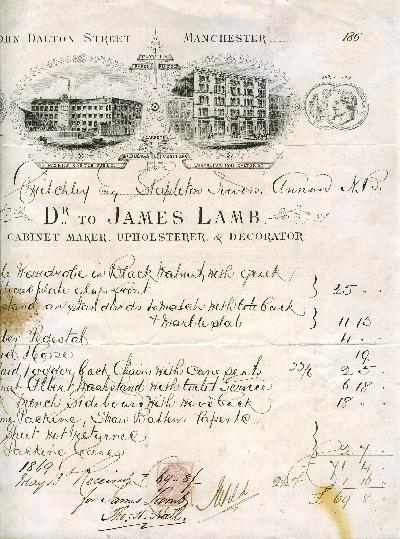
A HISTORY OF LAMB OF MANCHESTER
A BRIEF HISTORY OF CHRISTOPHER
PRATT, BRADFORD
Note on Labelling Techniques
Trade labels found on furniture made by certain Yorkshire
firms during the nineteenth century are often most instructive.
Roodhouse of Leeds and Richardson of Hull, for instance, included,
in addition to the printed information, details of the order
number, date and workman's name. Transcripts of the labels
employed by Joseph Nutter, Pratt & Prince and Christopher
Pratt & Sons, are provided elsewhere, they enable each
item to be placed within a definite period, but do not record
any supplementary data. After about 1880 the firm frequently
introduced a second label-slightly larger than a postage stamp
inscribed with a number, but as yet, no method of using these
figures as a key to precise dating has been devised. After
about 1900 Pratts sometimes fixed a small metal plaque on
their furniture and paper labels incorporating the monogram
'C.P.S.' start to appear. When they became a limited company
in 1913 the abbreviation 'Ltd.' follows their name. One instance
of the impressed initials 'C.P' have been noted on the seat
rail of a chair known to have been made by the firm c.1905.
During the 1920s a label inscribed simply 'Pratts of Bradford'
may be encountered.
BAMBOO FURNITURE MANUFACTURERS
ABBOT, E. C. & CO., 10 Clerkenwell Green, London, E.C.
(1898)
AIDZU BAMBOO CO., 204 New North Road, & 93 Rivington
St, Curtain Road, E.C. (1884)
ANTIQUE & FOREIGN FURNITURE CO. (CAWLEY & CO.), 4
New Inn Yard, Gt Eastern St, E.C. (1882)
ARDWICK WICKER CHAIR MANUFACTURING CO., Tiverton Grove, Tiverton
St, Manchester (1922)
ASTON BAMBOO FURNITURE CO., 50 Bracebridge St, Aston Road
& 6 Brook St, Birmingham (1899)
ATKINS, THOMAS EDWARD, 32A Euston. Square, N.W. (1899)
AUSTRIAN BENTWOOD FURNITURE CO., 85 Gt Eastern St & 3
Newgate St, E.C. (1892)
B. & WICKER FURNITURE CO. LTD, 34 Gt Eastern St, E.C.
(1909)
BAMBOO ART WORK CO., 44 Sun St, Finsbury, E.C. (1893)
BAMBOO COMPANY, Star Works, Gt Sutton St, E.C. (1894)
BAMBOO FURNITURE MANUFACTURING COMPANY, I46A & 152 Offord
Road, Barnsbury, N. & 6 I Poole St, New North Road, N.
& 103 George St, Croydon (1895)
BAMBOO & UPHOLSTERY CO., LTD, 34 Gt. Eastern St, E.C.
(1908)
BAKER, SAMUEL, 7 Mott St, Birmingham (1903)
BANKS, GEORGE, 100A Shakespeare Rd, Stoke Newington, N. (1907)
BASS, MATTHEW, Rheidol Mews, Rheidol Terrace, Islington,
N. (1906)
BASTENDORFF, JOSEPH & CO., 9 & 11 Essex Rd, 5 Charles
Place, Euston Square, N.W. & 77 Chenies Mews, W.C. (1891)
BASTENDORFF, PETER & CO., 4 Euston Square, N.W., 23 Harrington
St, Hampstead, N.W. & I S Edward St, Hampstead Rd, N.W.
(1885-1893)
BASTENDORFF, SIDNEY, Rheidol Mews, Rheidol Terrace, Islington,
N. (1903)
BATH, F. & CO., 49 Skinner Lane, Birmingham (1899)
BEETLES. C. C., 93 Herbert St, New North Rd, Hoxton, N. &
45 Essex Rd, N. (1894-1900)
BEAUMONT, G. & CO., 158 High Holborn (1881)
BELSCHNER, F. & CO., 41 Moor Lane, E.C. (1901)
BETHELL, T. H., St Mary Axe, & Bevis Marks (1894)
BILL, HUBERT, 14 & 15 Little Camden St, Camden Town,
N.W., 24 Margaret St, W., 101A Dean St, Soho, W., 330A Holloway
Road, N., I78A Oxford St, W., 43 Warren St, W., 42Whetstone
Park, Holborn, W.C., 12 Duck Lane, Soho, W., 131 Wardour St,
W. (1869-1905)
BONELL, THOMAS JOHN, So Bracebridge St, Birmingham (1899)
BRAUN & FRANCIS, 84 & 86 Tabernacle St, E.C., 372
Hackney Road, N.E., & 211 Hackney Road, N.E. (1898)
BREST, MRS GERTRUDE, 79 Tudor St, Canton, Cardiff (1906)
BROWN, FRANK, 278 & 292 Tabard St, Boro', S.E. (1898)
BURVILLE & CO., 239 Hackney Road, E.2. (1922)
CANE & CO., 1 Iremonger Row, E.C. (1903)
CARLO BENJAMIN & CO., 7 Cropley St, Hoxton (1898)
CASPAR & CO., 76 High Holborn, W.C. & 26 Red Lion
Square, W.C. (1892)
CAWLEY & CO., 7 & 8 Charlotte St, Great Eastern St,
E.C. (1882)
CLAYTON BROS, 22A Chappell Lane, Brownlow Hill, W. Liverpool
(1894)
CLEMENTS, MRS ELIZABETH, 52 Russell St, W. Liverpool (1913)
CLOZENBERG, Messrs & SON, 119 Curtain Rd, E.C. (1906)
COHEN, B. & SONS, LTD, Curtain Rd, E.C. (1906)
COHEN, LEWIS, 69 Hare St, Bethnal Green, E. (1899)
COLLIER, HERMAN & CO., 66 Worship St, E.C. & 7 Vandy
St, E.C. (1898)
COLLIER, J. & CO., 17 Devonshire Square, E.C. (1889)
CORBLUTH, JOHN & CO., 33 Curtain Rd, E.C. & 17 Holywell
Row, Finsbury, E.C. (1895)
COULSON, JAMES, 34 York St, Westminster, S.W. (1902)
CRAWLEY MORRIS & CO., 64 City Road (1876)
CULLUM, JOHN THOMAS, 217 Hackney Road, N.E. (1896)
ELLMORE, W. T. & SONS LTD, Leicester & 16 City Road,
London (1886-1926)
EMPIRE BUILDERS LTD, 329 Hoxton St, N. I. (1919)
ENGLANDER, ADOLPH, 76 Luke St, Curtain Rd, E.C. & 34
Gt Eastern St, E.C. (1898)
ENGLANDER & SEARLE, 24, 31 & 33 Mare St, & 34
Gt Eastern St, Hackney (1904)
EVANS, WALTER GAMON & SON, 23 Netley St, N.W., &
Eden St, Hampstead Rd, N.W. (1888)
FALET, F., 10 Grays Inn Rd (1889)
FALET, WALKER & CO., Worship St, E.C. (1905)
FORTIER, URSIN, 65 Charlotte St, Fitzroy Square, W. (1885)
FRAMPTON, ELI, Upper Brook St Works, 68 Temple St, Manchester
(1907)
FRANK, MICHAEL & CO., 68 Old St, Luke's, E.C. (1892)
FREDERICK, JAMES (LONDON BAMBOO & WICKER FURNI TURE MANUFACTURING
CO.), 59 & 61 Wigmore St, W. (1884)
FRYER & CO., 19 Archer St, Camden Town, N.W. (1895)
FRYER, FRANK & CO., Little King St, N.W. (1893)
GARRET, CHARLES GEORGE, Bath Place, Euston Rd, N.W. (1898)
GEMS, ERNEST, 78 Wigmore St, W. (1885)
GEMS, JULIUS & CO., 94 East, Manchester Square, W. (1885)
GOODWIN, THOMAS JOHN & SON,185 Old Kent Rd, S.E. (1906)
GOTLIEB & HACKER, 22, New St, Bishopsgate, E.C. (1900)
GOTLIEB, NATHANIEL & CO., 66 Valance Rd, E. (1897)
GRAY, GEORGE ALFRED, 2 8 Cowper St, E.C. (1898)
GREIFENBERG, LOUIS, 47 Rounton Rd, Bow, E. (1898)
HARDSTAFF, T., Carrington St, Nottingham (1886)
HARLEY, FREDERICK & CO., 82 Mary St & 92 Steward
St, Birmingham (1899)
HAROSKE, FRANZ, 28 Well St, Wellclose Square, E. (1895)
HAYWARD, WILLIAM, 2 St Thomas's Yard, Ben Jonson Rd, E. (1898)
HEINRICHS & CO., I33 & I35 Old St, 1 & 2 New
St, Old St, E.C. & 123 Central St, St Luke's, E.C. (1888)
HODSON, B., I3 Wrentham St, 182 Sherlock St, Birmingham (1910)
HURLES, W. & CO., So Hurley Rd, Kennington (1906)
HUTCHINGS, E. & SONS, Weymouth (1893)
IREMONGER, J., Romsey (1887)
IVERSEN & EIDAM, 6 Tottenham St & 14 Little Howland
St, W. (1881)
IVERSEN, JACOB, 14 & 15 Little Howland St, W. (1898)
JACOBS, DANIEL & SONS, 75, 80, 102 & 109 Hackney
Rd, N.E. (1892-1935)
JAMES, THOMAS & CO., 111 Speedwell Rd, Hay Mill, Yardley,
Birmingham (1905)
JONES & CO., 16 Queens Rd, Bayswater, W. (1897)
JUST, 0., 1 Gloucester St, Camden Town, N.W. (1883)
KAHLOW, CARL, 13 Goldsmith's Row, N.E. (1899)
KENDAL, MILNE & CO., Deansgate, To Police St, 8 Ann St,
& King St, Manchester (1907)
KESTERTON, ALFRED, 14 & 16 Chapman St, Manchester (1907)
KOHN, BAPTIST, 18 Drummond Crescent, N.W. (1885)
KOHN, J. B., 170 Pentonville Rd, N. (1983)
KRIS, L., 42 Hanbury St, E.1 (Lawrence & Son) (1928-1935)
LACEY, HENRY JAMES, 19 Archer St, Camden Town, N.W. (1905)
LAMBERT & CO., 12 Furnival St, E.C. (1895)
LANGER, HUGO, 39 Clipstone St, Great Portland St (1881)
LARNER, ARTHUR, Anchor Yard, Old St, E.C. (1894)
LAUDENBACH, BERNHARDT, z 5 High St, Camden Town, N.W. (1898)
LAUDENBACH & SELF, 249 & 251 High St, Camden Town,
& 49 Wilson St, Finsbury Town, E.C. (1896)
LEWIS, MRS HANNAH, 25 Liverpool Rd, Manchester (1907)
LEVY, MORRIS, 9 Holywell Lane, E.C. (1903)
LIGHT, C. & R., 140, 142 & 144 Curtain Rd, E.C. (1881)
LINES, GEORGE & JOSEPH, 457 Caledonian Rd, N., 27 Hackney
Rd, N.E. & North Rd, Cattlemarket, N. (1894)
LUCKETT, THOMAS, Mark Lane, Pershore St, Birmingham (1895)
MACHELL, ALEXANDER, 306 Vauxhall Bridge Rd, S.W. (1903)
MAJAKI & SON, 57 Bridport Place, N.I (1920)
MARCO, CHARLES & CO., 6 New Zealand Ave, Barbican, E.C.
(1905)
MARSTOW, EDWARD & CO., LTD, 34 Barbican, E.C. (1890)
MATTHEWS & CLARK, 93 Rivington St, & 11 Pownall Rd,
Dalston, N.E. (1896-1905)
McGII.L, JOHN THOMAS, 71 Barnsbury Rd, N. (1893)
MEER, CHARLES, 4 Great Arthur St, E.C. (1899)
MERRIFIELD & CO., address unknown (1900)
MIKADO COMPANY, Gooch St, Birmingham (1893)
MILNER, JOHN, John Bright St, Birmingham (1898)
MIMMS, WILLIAM, 26 & 27 Rheidol Mews, Rheidol Terrace,
Islington, N.1 (1922)
MODEL & CO., 26 Tottenham St, W., 4 North St, Charlotte
St, Fitzroy Square, W., & 9 & 10 Charlotte Mews, Tottenham
St, W. (1881-1900)
MONTGOMERY'S, address unknown (1926)
MORRIS, WILLIAM, 24 Freeman St, Birmingham (1887)
NEEDHAM, W. F., (William Frederick), 69 Camden St, Branston
St, Works, Gt Hampton St, & Newhall Hill, Birmingham (1888-1901)
NEWBY, VALENTINE & CO., Boston Yard, North St, Pentonville
N.1 (189 6)
NEWMAN, ISADORE, 5 & 7 West Derby St, E., & Metley
St, E. Liverpool (1917)
NORRIS, HENRY, 36 Charles Square, Hoxton, N., 25 Christopher
St, Finsbury, E.C., & Crown & Shuttle Court, Shoreditch,
E. (1898)
NIXON, WILLIAM, 356 Summer Lane, Birmingham (1899)
NORRIS & WHITE, 32 Hoxton St, N. (1901)
PAYNE, R. C. & CO., 6 Lloyds Ave, E.C. (1906)
PEAKE BROS, 50 Summer Hill Rd, Birmingham (1899)
PERLMAN, AARON, 32 Cannon St Rd, E. (1899)
PIERCE WILLIAM, 151 Stanhope St, Euston Rd, N.W. (1890)
PLESSER, REUBEN, 44 Hanbury St, E.1 (1922)
PRATT, WILLIAM THOMAS DAVID, 136 High St, Bordesley, Birmingham
(1899)
PRIEST, MARIANS & CO., LTD, St Mary Axe, E.C. & 30
Bevis Marks (1905)
REISDORF, CHARLES, 3 & 4 Little Howland St, W. (1898)
REINOLD, F., 3 Hanover Court, Milton St, E.C. (1906)
REUBEN & ISAACS, 44 Hanbury St, E. (1916)
RICHARDS, JOHN BEDDOW, 1A Stafford St, H. Manchester (1907)
RODGERS, WILLIAM, 44 Hanbury St, E. (1914)
ROSENTHAL & CO., 7 St John St, Bethnal Green, E. (1898)
SAYERS, SON & CO., Maville Basket Works, Basford, Notts.
& Beech Ave, Nottingham (1905)
SCHOFIELD & BURVILLE, 239 Hackney Rd, E.2 (1919)
SCHNEIDER, HENRY, 6 Shacklewell Lane, High St, Kingsland,
N.E., 27 Mildmay Park, N., 105 Balls Pond Rd, N., & 66A
Stean St, Haggerston, N.E. (1898)
SCOTT, G. W. & SONS, 43 Old Compton St, W., & Charing
Cross Rd (1889)
SCRIVING & GALE, 101 Popest, Birmingham (1904)
SEARLE & LEAKIN, 55 Church St, Bethnal Green, E. (1926)
SEIDEL, HANS, 85 Chiswell St, E.C. (1899)
SELF, HERBERT HENRY, 49 Wilson St, Finsbury, E.C. (1898)
SHAPIRA, WOOLF, 91, Chicksand St, Brick Lane, E. & 90
Buxton St, Mile End, E. (1898)
SHULNICK, ISAAC, 14 Virginia Rd, E.2 (1923)
SPENCER, ALFRED ERNEST, 1 Carver St, Birmingham (1895)
STANLEY & CO., 237 Vauxhall Bridge Rd, S.W. (1907)
STEPTOE, JAMES, 11 Leopards Yard, Wilmer Gardens, Hoxton,
N., 23 Harrington Rd, N.W.1, & Regents Park Studios, Park
Village East, N.W. (1899)
STOCKWELL, S. J. & CO., Swan Buildings, 20 Swan St, &
36 Berry St, London Rd, Manchester (1907)
SULLIVAN, DANIEL, 233 Stanhope St, N.W., & Park Village
East, N.W. (1899)
TAYLOR, W. H., 27Mildmay Park, N. (1916)
VASS, JOSEPH, 26 & 27 Rheidol Mews, Rheidol Terrace,
N.1 (1924)
VOYCE, THOMAS, 18 Broom St, Birmingham (1897)
WEAVING, FRANK, 41 Charterhouse Square, E.C., 70 & 71
Chiswell St, E.C., 32 Culford Rd, Kingsland, N. & 51 Floral
St, Covent Garden, W.C. (1891)
WEAVING & HEYMANN, 32 Culford Rd, Kingsland, N. (1908)
WHEELER, ELIJAH & SON, George's Row, York Rd, City Rd
(1894)
WHITE, C., 1 Northdown St, Pentonville, N.1 (1925)
WHITE, JAMES, 10 Horsefair, Birmingham (1896)
WILFORD, THOMAS & CO., 27 Colmore Row, Birmingham (1894)
WILLIAMS, J. & SONS, 46 Curtain Rd, E.C. (1894)
WOLFSON & SONS, LTD, address unknown (1926)
Y., ED. J. & SON, 9-1O Kingsland Green, E.8 (1924)
YEARLEY BROS., Alpha Place, Caledonian Rd, N. (1900)
YEARLEY, EDWARD JAMES, 32A Euston Square, N.W., 81 Hampstead
Rd, N.W. & 3 St Philip St, New North Rd, N. (1898)
ZUREICH, JOSEPH, 31 Mortimer Market, W.C. (1896)
Addresses are in London unless otherwise stated. The dates
at the end of each entry are the approximate years when the
manufacturer produced bamboo furniture. (Information from
Antique Bamboo Furniture by Gillian Walkling)
LIST OF FURNITURE MAKERS IN
THE WYCOMBE DISTRICT INCLUDING HIGH WYCOMBE
LIST COURTESY OF
Wycombe Museum www.wycombe.gov.uk/museum
A F Furniture High Wycombe to 1968 Made occasional
furniture & 'Happen' range. Merged with Fassnidge 1968
A & G Furniture Watercroft Farm, Cadmore End 1995-99
- cabinet makers
Abbott Bros Guildmaster Wks, Desborough Rd 1971-89
Abbotts Productions Lane End Rd Sands 1939
Abbott Aubrey West Wycombe 1928, 1931
Abbott Copeland, Alfred Kitchener Road 1935; 1939
Abbott and Stone West Wycombe 1924
Abrams, Henry Easton St 1842, 1847
Abram, William St Mary St 1847
Adby, James Newland 1869
Aldridge, William Totteridge Road 1888; 1895
Allen, A.J. 52 Baker Street 1905, 1907; 1911; 1915;
1924; 1928; 1935; 1939; 1952/3, 1958/9, Chapel La 1963 ...
1999 Hotel, hospital & bar furniture. Moved to Sands from
Baker St 1961. Est 1890. Moved to Baker St 1898. Next door
factory in Sands already run by its subsidiary Parkside Panels.
P
Allen and Co Oxford Road 1915
Allnutt, Walter Stokenchurch 1935; 1939
Allwood Products Unit 8, Oxford Rd Piddington 1981-89
Allwood Designs Unit 33g, Princes Est., Princes Risborough
1994 ...
Almet Lancaster Rd 1972, 73 Tubular metal furniture
Amos, C.W. Beechwood Road 1976 Closed down Sept 1995,
convertibles
Anderson, Harry (Ltd) Stokenchurch 1928; 1935; 1939-86
By 1972 specialised in school furniture
Anderson, Thomas 3 Denmark Street 1875 - was a cane
merchant
Anstead, T.W. Stokenchurch 1939
Antock Lairn (Labofa) Lane End Rd 1966, Lncaster Rd
1971 ... 1999 Est 1963. Office, conference furniture. Came
to Wycombe from London, 1965
Archers (High Wycombe) Ltd Baker Street 1952/3, 1958,
West End Rd 1962-76 Founded as Walter E Ellis, West End Rd,
1887. Made library, boardroom, bank furniture and for embassies
and hotels. 'Stylemaster' office range. Taken over by EJJ
Archer in 1930, made wide range but gradually specialised
in office furniture, were 'pioneers of revolving and tilting
type of executive armchair'. Became Archers in 1949, and by
1950s was making music furniture as well as office.
Arniston Bathrooms Arniston House, London Road 1987-9
Arnold, C (MBEW) Marlow Bottom 1958/9-1969/70 1965,
referred only to its needlework tables
Asconti London Ltd 3 Copyground Lane 1981-87
Ashald, John Bull Lane 1853
Ashalls, John West Wycombe 1798
Ashby, Jnr Stokenchurch 1924; 1928
Atkins, Alfred Stokenchurch 1935; 1939
Atkins Bates & Co Mill Road, Stokenchurch 1962-80
Atkins & Rabone 195b Desborough Av 1969-76
Atkins & Mudie Stokenchurch 1924
Avery, Richard Naphill 1888
Avery, William Tetsworth/Radnage 1895 & 1899
Avery, White and Avery Ogilvie Road 1924
Ayre, Frederick William 27 Baker Street 1924; 1928,
1948/9, 1958/9
Ayres, Robert Turville 1891, 1895
B & S Furniture Goodchilds Workshop, High St,
Lane End 1971, 1979
Bailey & Toms Nutfield Lane 1933
Bailey, J (and Sons) Lindsay Ave/ Nuffield Lane 1911;1915;1924;1928;1935;1939,
1948/9
Bailey, John Bernard Church St, Princes Risborough
1877; 1883; 1888
Bailey, Joseph Naphill 1891
Bailey, Joseph and G Oakmead 1888; 1895
Baker, Amos Jas Shaftsbury St 1895
Baker, George Princes Risborough 1823/4
Baker, Harold Ltd Grafton St 1933, Desborough Rd 1952/3
Baker, W.F. ltd West End Rd/ Bellfield Rd 1952/3
Ball and Blackwell Desborough Rd 1888
Ball and Co 17 Denmark St 1875
Ball and Harvey Dovecot 1935
Ball, Henry 8 Temple St 1875
Barlow, Edmund West Wycombe 1842, 1847
Barlow, H and Co Oakridge Ave 1924; 1928; no.12 1933
(also 'Wycombe Upholstery Co. behind 1)
Barnes, Edwin 2 Baker Street 1905, 1907, 1909
Barnes, Branch & Co Ltd Queen's Rd 1933, 1948/9
1958/9
Barney, John Henry Church St, Stokenchurch 1924
Barrett & Large Jubilee Rd 1905
Barrett, T Newland St 1905, 1909
Barrett, W. Newland 1911-1952/3 (all refs in between),
Ogilvie Rd 1962-8; in 1965 three sites at Magnet Wks Ogilvie
Rd, Jubilee Wks Oakridge Rd, and Newland Wks Newland Rd. 'Chairs,
settees and convertibles'
Bartlett, John North End, Turville 1883, 1888, 1891,
1895
Bartlett, William Heath, Turville 1891, 1895
Bartlett, William (and Son) Slater Street 1875-1952/3
(all refs in between) Grafton St 1962-99
William Bartlett & Sons. Est 1864, moved to Grafton St
1901. Repro Regency furniture. Emp. 135, 1995. Had showroom
on Fitzroy St. Emp 300, 1938 Founded 1864, by Wm Bartlett
in partnership with a friend, making Windsor chairs in a barn.
Late 1890s started on cabinet goods. Limited in 1918. Made
plane fuselages in WWI. Strongbow range dates at least to
1965. P, C
Bartlett, Scott & Co Queen's Rd 1905
Barton, Richard London Rd 1847
Batchelor, Alfred Leigh Street 1888; 1895
Bateman, Samuel W Desborough Rd/ St Mary's St 1888;
1895
Bateman, William St Mary's St 1907; 1911
Bates, Cecil Richard (and Sons Ltd) Wycombe Rd, Stokenchurch
1935; 1939, 1948/9, 1924, 1928, 1931-81 Mr Bates was warden
of St Francis's Ch, Beacons Bottom, so Bates made the chairs,
1936. Illus in Starey & Viccars. Est 1921.
Bates, D. Stokenchurch 1907
Bates, H. Bridge St 1924
Bates, J.E. Stokenchurch 1935; 1939
Bates, J.W and Sons Ltd West End St, Wendover St? 1939;
1952/3, 1948/9, 1962-6
Batten, John Jnr High Wycombe 1798
Bavin, James Quoiting Place, Marlow 1830
Bavin, John West Wycombe 1798
Bavin, William West Wycombe 1790; 1798
Beck, Edmund Newland 1847
Beckett, Henry Crendon lane 1853
Bed Room Bull Lane 1971-2
Bellamy, P.E. and Co Desborough Rd 1928
Bennell, Robert Stokenchurch 1854
Biggs, B. Stokenchurch 1948/9
Biggs, Frank The Nooks, Sands 1924
Biggs, William Stokenchurch 1881, 1883, 1891, 1895,
1899
Birch and Alpe Ltd Kitchener Rd 1929; 1952/3, 1958/9
P Charles William Birch (apprenticed at 13 to Birch) was William
Birch's grandson. He left to set up Birch and Alpe in about
the 1920s because he didn't have 'parity of esteem' with Walter
Birch's son (according to a document in CBS) Alpe was his
wife's maiden name. Made high class upholstery - 3 piece suites
- and furniture for shipping lines, including the Queen Mary.
Employed around 40. After closure the factory was let out
to Tyzaks and then sold to Stuart Linford (information from
Pam Darvill-Evans, Museum Volunteer, Jan 2007. Charles William
Birch was her grandfather.
Birch, Charles Queen's Rd/ Oxford Rd 1875; 1888; 1907;
1909
Birch and Cox Queen's Rd 1911; 1915
Birch (and Co), William Newland/Denmark St/Leigh St
1853, 1864-1952/3 (all refs in between) - 1966
The firm of William Birch appears in trade directories in
1853 in the Newland area of High Wycombe, then a fast-developing
district of industry and working-class housing. However, family
tradition related that he began chairmaking in the 1840s.
In 1883 William son Walter Birch started his own chairmaking
business in Castle Street, after beginning some years before
at the back of The Woolpack pub in Oxford Road. He was followed
by his brother Charles whose furniture factory in Queen's
Road appeared by 1888 and carried on in business until World
War One. Walter took over his father's firm by 1895 when it
appears as 'Birch and Company' with premises in Denmark Street.
The Denmark Street factory was rebuilt according to the latest
modern specifications as a three-storey, all-brick building
in about 1898, as opposed to the older style factories which
had a brick ground floor and a wooden upper storey. It was
supposed to lessen the risk of fire but itself burned down
very soon after being built. The firm maintained offices in
Euston Road for many years until it became clear that most
of the London buyers were coming to Wycombe to do business.
Birch's opened a second site in Wycombe at Leigh Street, where
the whole business was concentrated between 1931 and 1935.
The firm seems to have been among the first to branch out
into general furniture making in addition to chairs alone,
around the turn of the century. It pioneered the development
of Arts and Crafts influenced furniture locally, and employed
well-known designers such as EG Punnett, George Walton (who
worked with Mackintosh) and Whitehead. Employed 350 in 1938.
Made range called 'Birchcraft' circa 1950s.Birch's was taken
over by Gomme's 1954. P, D, C, CH. Records also at County
Archives/Centre for Buckinghamshire Studies.
Bird, Alfred Stokenchurch Illus in Starey & Viccars
Bird, Hy Stokenchurch 1935; 1939
Blackmur, W.J. Ltd Lane End Rd 1952/3
Bledlow Woodwork Drum Grange, Bledlow 1984 - listed
as furniture restorer, but advert also states 'furnitture
supplied to individual requirements'. By 1987, repairs only
mentioned. Prop Nigel Smith - moved to Meadowside, West Lane,
Bledlow
Bloxsidge, Reginald Easton St 1928
Blue Line Office Seating 96 Kitchener Rd 1984-5
Blue Line Office Seating SEE A Parker
Bobby & Co, Ltd Slater St 1924, 1933 & Easton
St (betw 28-35), 1933 Facty burned down 1922. Est. 'some time
before 1919', owned large dept. stores, in Bournemouth etc.
150-200 working there at one time. Kept workers on during
1919 lock out and paid them back pay after. Made all sorts
of chairs, including repros, barbers chairs, shop fittings,
prams, invalid carriages. Changed to Hughenden Chair Works
because they supplied competitors of their own shops. Taken
over when war broke out and ceased trading. P
Bond Bros 500 London Rd/The Pinions 1924, 1928, 1931,
1939, 1948/9
Bonnett and Ford (Ltd) Bonford Wks, Grafton St 1924;
1928; 1935; 1939, 1952/3 - 1982
Bonnett, Ford & Mealing Grafton St (same as above)
1933
Boorman, Philip orig. Haleacre Wkshops, Little Kingshill,
1983; Slater St 1987-96 Handcarved, repro chairs
Boreham, F. Duke St 1924; 1928; 1935; 1939, 1948/9
Borretts, William 15 Ogilvie Road 1968-9
Bowden, Samuel Temple End/15 Newland Meadow 1864; 1869;
1875
Bowler, Charles West Wycombe 1842
Bowler, Joseph (Cab) Oxford Rd 1842, 1847
Branch, TH & AT Church Rd, Tylers Green 1963-76
Branch & Knight West End St 1933
Brickwell, John High Wycombe 1798
Brickwell, Thomas High Wycombe 1798
Bridgewater, William Paul's Row Ward, Church lane 1823,
1830
Bridgewater, William Jr Downley 1830, 1842
Brinden, Frederick Hughenden Rd 1888; 1895
Bristow, Enos Downley 1888; 1895
Bristows Bates Estate, Wycombe Rd, Stokenchurch 1984
Bristow, Thomas West Wycombe Park 1847 - b.1818
Bristow and Townsend Copyground Lane 1952/3, Desb.
Pk Rd 1939, 1956, 1958 - 1982 Est 1933 in shed on Desb St
by FJ & Wilfred Bristow , MS Townsend joined in weeks.
To Sands 1935, Castles old facty in Desb Pk Rd 1938. Made
18th century repros and Carlton Collection range. Also Scandart
modern upholstered chairs, 1958, 1965. O, C
Britnell, Arthur Turville 1891, 1895
Britnell, William Bledlow/Tetsworth 1877
Britwell, Jabez Stokenchurch 1924; 1928; 1935; 1939
Brown, E.M.F Ltd/Quality Town Duke St 1952/3, Church
La West Wycombe 1963-99 Now Browns of WW. Est by Edith Maude
Brown in Duke St c.WWII, husband Charlie joined afterward.
Bought by Mr Hinds 1977. Occupied old facty of Quality Town,
or Mr Giles, used since 1902. Kept on some of the old staff.
Restored and repaired chairs, also chairs for banks, boardrooms,
repro, one-offs, bedheads, P
Brown, John High Wycombe 1798
Brown, William Lacey Green 1887, 1895
Bryant and Fryer St Mary's St 1895; 1905 ('John Bryant');
1907
Buckingham, Michael High Wycombe 1798
Buckinghamshire Chair Co Ltd St Peter St/ Victoria
Rd, Marlow 1877-1911 (all refs) Est 1872. Took advantage of
availability of labour because of 1872 strike.
Burnham, Rowland Alex Booker 1928
Burr Brothers High Street 1924, 1928
Buswoods Ltd 19a Spring Gardens Rd 1980-82
Butler, Donald, Upholstery Totteridge Works, Totteridge
Rd 1987-96 Est 1974, originally did reupholstering then making
in Desb Rd facty in 1979/80, moved to Totteridge Av 1986
By Design 8a Lindsay Av 1989
Bye, Thomas 39 Water Lane 1875
Caffall, John Hobbs Temple End 1853
Caffall and Keen Queen's Rd 1895; 1907; 1911;1915 Had
showroom on Fitzroy St Made most expensive grade furniture
in late 1800s.
Caine & Walker Conegra Works, London Rd 1924, 1928,
1931, 1933
Cannon, John London End 1816, 1830 b.1780
Cannon, Charles London End 1842
Cannow, John High Wycombe 1798
Carlton Collection Old QA Factory, Bassetsbury Lane
1983-89 New company which bought the business of Bristow &
Townsend and adopted the name of its range.
Carr, Joseph Newland 1842-53
Carr, Henry Newlands 1851
Cartwright, B.W. Prestwood 1883
Cartwright, Benjamin and Son 17 Mendy St 1875-1952/3(all
refs in between) - 1989 - kept Rose & Crown 1965, manufactured
Selectapoise range of upholstered chairs and settees. 'CV
& HP Cartwright', 1933
Cartwright, C. Mendy St 1905, 1909
Cartwright, William Mendy St 1864; 1888 (maker)
Castle Brothers Desborough Park Rd/ Cressex 1911; 1915;
1924; 1939 Booker 1948/9 First facty in Cressex, 1937. Est
by Henry & William Castle 1908, Limited co. 1934 P, D
Castle Brothers Furniture Ltd Coronation Rd 1952/3
Castle, H.J. & Abbott Oakridge Rd 1924, 1929, 1935,
1948/9
Castle, William A 173 Hughenden Rd 1931, 1939
Catton, Amos Lane End ?1864; 1877; 1883; 1888; 1895
Took over Jo Savage's business, pattern book bought by Leeds
Art Gallery in 1990
Chadley, James (Cab) Frogmore Ward 1823
Cheese, J. Newland 1905, 1907;1911;1915;1924;1928;1935;1939
&Sons, 1948/9
Cherry Orchard Works Spring Gardens Rd 1952/3 (prop-Bloxidge)
Child, Charles 25 Baker St 1905
Child, Charles Totteridge Rd 1905
Child, Edmund Baker St 1907
Chiltern Bedrooms Piddington 1982
Chiltern Hills Furniture Cromwell Wks, West End Rd
1982
Chilton Chair Works Ogilvie Road 1952/3
Chilton, Frederick West Yd, Slough La, Saunderton 1971
Chippy Heath Furniture Desb Pk Rd 1962, + furnishers
at West Wyc Rd, 1971 - 1978, 461 London Rd 1979- 82, Sales
Off. Only 1981, Abercromby Av 1983
Moved from Desborough Pk Rd to Fairmeadow Wks, WW Rd, formerly
Dancer & Hearn, 1968. Eric Heath is son of Jack Heath.
Spec in telephone seats in 'Louis, Regency, Jacobean, Modern
and Contemporary designs'
Clark, Charles Bowderys la/Oxf Rd/Mendy St/Water St
1850, 1851, 1853, 1864; 1875; 1888
Clarke, C. Newlands 1864
Clarke, J.R. Desborough St/ 8 Abercrombie Ave 1911-1952/3
(all refs in between), 1962-86
Reproduction chairs, 1975. Founded by John Clarke 1893, closed
1986. Utility maker in WWII but reverted to repro styles afterwards
with carving sub-contracted and hand polishing. Survived on
small orders and one-offs but closed because of lack of skilled
labour - in last year Maurice Clarke and son Laurence did
all the skilled work. 'Criterion' line in 1965 - though not
clear what this was. Named from Criterion Works. P
Clark, Thomas Queen's Sq/Canal 1830, 1839, 1842(Qs
Sq)
Clifford, J.H. 88 Hazlemere Rd, Penn 1972, 1984 - cabinet
makers
Collier, Archie Moor Common, Lane End 1924; 1928; 1931,
1935, 1939
Collier, Edwin (and Son) 16 Bridge St, Hughenden Rd/Westbourne
St 1875; 1888; 1895
Collier, Walter Marsh 1907; 1911; 1915
Collins (Furniture) 8 Dashwood Ave 1952/3-76 Fireside
chairs, 1965, 75
Collins, H. Downley 1864 Locked out his caners in 1872
and so started the strike of that year.
Collins, James Downley 1850, 1851, 1864; 1888 b.1821
Collins, W (and Son) Downley/Queen's Rd 1850, 1851,
1864; 1888
Coltman, Alfred Desborough Rd 1895; 1907; 1911; 1915;
1924 (Leigh St 1905, 1909)
Coltman, John Queens Sq 1847
Compton, William Bull Lane 1847
Constable & Philips New Rd, Princes Risborough
1984-91- kitchen furniture makers
Contract Incorporated ltd 148 Abercrombie Ave 1969
Cooper, John High Wycombe 1798
Cooper, Thomas jnr High Wycombe 1798
Cooper & Youens Widgington's Passage, St Mary St
1905, 1909
Cornwell Norton Frogmoor 1963-74
Cosy Comforter Spring Gardens 1984-96
Cotes, A. The Factory, 32 New Pond Rd, Holmer Green
1972-76 Tubular metal furniture
Couchman, William Head Oxford Rd 1842, 1847, 1853
Counter Productions Brow Wks, Copyground Lane 1987-94;
Grove Wks, Grove Rd Hazlemere 1995-9 - kitchen furniture
Cox, James (and Son) Ltd Oxford Road (corner with Westbourne
St) 1853, 1869;1875;1888;1895;1907;1911;1915;1924;1928;1929;1935
Employed 150 in 1870. Exhibited at Furniture Exhibition at
London Agricultural Hall, 1881. 'No firm of higher reputation
or greater importance' in 1890s. Est 1850 as Cox & Hussey,
dissolved 1865 and carried on by Jas Cox until 1880 when becomes
Cox & Son. Showrooms at 24 Finsbury Pavement. Exports
to Australia & New Zealand. 'Art Chair Makers & upholsterers'.
Old saw mills in Bridge St converted to separate company and
used for cabinet work. Reported in 1891 BFP as est. as Cox,
Hussey & Barrett about 1850 in Three Tuns Yard, then to
West End as Cox & Hussey, the 1862 Hussey moved to Hughenden
Rd. Cox bn Amersham, began as traveller to Thos Harris (West
Wyc) and Skull's. D. 1891 aet 77 P
Cox, John Bird in Hand 1875
Cox & Hussey 'Formed by the amalgamation of the
Cox & Hussey concerns' - Jo Mayes. Held tea party for
workers 1860 with 'choir of caning girls'. Was Cox & Barrett
- also unrecorded except in Mayes
Craft, Frederick Oakridge Rd 1907; 1911; 1915; 1924;
1928. 134 Desb Rd 1931, 1948/9
Craft, G. Desborough Rd 1907;1911;1915;1924;1928;1935;1939,
1948/9
Crawson, R. Crown Wks, Temple End 1972
Crook, Joseph Bell End/ High St, Princes Risboro' 1842-64
Croxson Brothers Ltd Temple St/ Dashwood Ave (1933)
1928; 1935; 1939; 1952/3, Q Alexr Rd 1962-76, spec in dining
chairs, 1968 ('GF Croxson', 17 Temple St 1933 - CHECK)
Crownfield Furniture Crownfield La, Saunderton 1962-3
Cutler, E. and Co Brook St 1924; 1928; 1935; 1939;
1952/3, Copygr La/Lindsay Av 1948/9, 1964-80
Contemporary handmade furniture, fireside, rocker & swivel
chairs. Wyecraft range, identified by St Lawrence's, WW, design
Cutler, H.C. 194 Micklefield Rd 1962-6
Cutler, Richard High Wycombe 1798
D & S Furniture Lincoln Rd 1966
DMI Fabrications 111/121 London Rd 1987-89, Halifax
Rd 1988-89
Dalmotte & Harding 9 Frogmoor 1924, 1928
Dancer and Hearne Brothers Penn St/Holmer Green/ 1895;
1907; 1911; 1915; 1931; Lindsay Av 1935; 1939; 1952/3-78 (office
in Frogmoor 1969) Traditionally Dancer & Hearne is supposed
to have been founded by William Hearne, a 'bodger' at Penn
Street, in 1840, in a one-man workshop shed behind the Hit
& Miss pub. When he died, his widow Eliza married Samuel
Dancer who took over the business but turned out to be a drunk
and was ousted by the Hearne brothers Albert and Alfred. These
details seem to be almost completely untrue! (Advert in 1958
Guide says 1860 is founding date).
William Hearne, aged 27, and his wife Eliza, a lacemaker,
appear in the 1851 Penn Street census. He was a labourer.
Sometime between 1861 and 1871 - the Hearns do not appear
in the 1861 census - he established the Hit and Miss, amalgamating
a series of cottages. The pub still survives. By 1881 William
had indeed died and his widow had married Samuel Dancer, a
labourer from Beaconsfield recorded in Penn Street in 1861.
He was also a widower. Samuel took over the Hit and Miss by
1881, when he appears as 'publican and chair factor'. Living
at the Hit and Miss was William Hearne's son Alfred, then
aged 20, a chairmaker. So it appears that Alfred was making
the chairs while Samuel sold them. This was probably still
the case in 1891: Samuel Dancer is still recorded in the trade
directory of that year as landlord of the Hit and Miss, but
Dancer & Hearne does not appear.
The firm is first recorded in the 1895 trade directory. A
photograph of that date shows 31 employees. The listing gives
the firm's location as 'Penn Street and Holmer Green', and
the Holmer Green factory, supposedly based in Factory Street
(now Orchard Way), was used by the company until some time
after 1939 but nothing more is known about it (company's own
broadsheet c.1959, see HW Library, says it was closed in 1920s).
Dancer & Hearne grew steadily to become one of the biggest
furniture factories area: by 1938 it had around 500 employees
and was producing 450,000 chairs a year. A series of famous
photographs shows the 'Big Chair', a 6 ½ -foot high
Windsor wheelback chair made for the British Industries Fair
in 1934. In 1935 the firm took over a factory on Lindsay Avenue,
High Wycombe, which it maintained until 1967 (again, company
history says this was sold 1957). There were also premises
at 'Fairmeadow Works', West Wycombe Road, High Wycombe, which
were taken over by Chippy Heath in 1968.
When orders were slow in the late 1930s, Cecil Hearne played
upon a connection with Geoffrey de Havilland the aircraft
manufacturer (who had been born in Terriers on the north side
of High Wycombe) and began making Tiger Moth aeroplane parts
for the de Havilland firm. During WWII the Penn Street factory
was given over completely to making parts for the Mosquito
and the Lindsay Avenue site also made plane parts. This was
a line the firm returned to in 1952 when orders also declined
and workers at the Ammanford factory in South Wales (1949-57)
had to be laid off.
By the 1960s Dancer & Hearne was producing mainly wooden
chairs for Government contracts and schools, and dining chairs
for other furniture firms, but the company made losses in
1962 and 1963 and only small profits afterwards. in 1967 it
was bought out by Parker Knoll. The new Production Manager
put in at Penn Street found what he called 'industrial anarchy'
with out-of-date equipment and a 'chaotic situation'. The
final blow came when the Ministry of Education decided to
abandon wooden chairs in favour of plastic and metal, depriving
Dancer & Hearne of the core of its business. The Parker
Knoll Group closed the company down in 1970. P
Darkinsa Sands Ind Est, Lane End Rd 1983-88
Darvill, William Frogmoor Gardens 1824, 1869; 1875
recorded in Chesham 1842-63
Davis, W. Ltd Suffield Rd/ Rutland St 1948/9, 1956.
1958, 1964-84 (Loakes Rd 1933) Est 1924, at 99 Richardson
St, then Rutland St 1927, later acquired Forward & Donnely
site at Temple End. Emp 120 before closing 1980. Traditional
& contemporary dining furniture, also Jens Risom Design
Furniture of New York. Church chairs, 1975. 1958, repro and
contemporary dining chairs, contractors to Admiralty and Ministry
of Works.
Davis & Davis Loakes House, Suffield Rd 1982-4;
308 Hughenden Rd 1985-88 formed from W Davis (qv), est 1980
- Mr Davis & wife who finish upholstery etc. & contract
out all other work. Now in Bisham. Supplied Windsor Castle,
hotels, embassies.
Davison Highley Old North Wks, Piddington 1992- Founded
1929, still comprises Davison family members. Carries out
prestigious made-to-order contract work largely for architectural
practices but also for hotels, companies, etc. C
Dawsons Seating Sandown Works 1946, 1964, 1965 Public
& domestic tip-up seating, sole contractors to ABC cinemas.
Subsidiary are Foresyte Furniture, engineering. Est 1946,
lecture theatre chairs in 1965
Day and Bedwell Slater St 1928, 45-7 Gordon Rd 1933
Day, Robert Frogmoor Gardens 1924
Day & Woods 19 Frogmore (rear) 1933
Deacon, Charles William West End Road 1888
Dean, Archibald and Co Queen Street 1924; 1928
Dean, Jas (and Sons) Naphill/ Stokenchurch 1924; 1935
Dean, James (and Sons) Stokenchurch/Naphill 1899, 1907;1911;1915;1924;1928;
1935;1939, 1948/9, S'ch 1962 By 1940 making up chairs from
seats bought elsewhere. Machines powered by oil engine.
Deane, Frederick Desborough Road 1939
Deane, NW Nutfield La 1971-78
Deane, William Stokenchurch 1915; 1924; 1928; 1935
Deane, W.H. Wooburn Green 1978 Awarded one of three
contracts for hospital furniture in 1966, and made furniture
for hospitals all across country. Bought by Glaxo's Matburn
Holdings, 1968. Began trading 1947. By time of closure had
84 workers and was owned by Deanes Holdings, and was making
office furniture. Management buyout 1985, 150 workers 1986.
D, C, P
Desking Systems Valley Wks, Lane End Rd 1982-3
Devalake Lincoln Rd 1976-99 C
Devocrest Stuart Rd 1974
Dimmock, P. Totteridge Road 1907; 1911
Direct Furniture Co Tylers Green 1935; 1939
Dixon, Henry Frogmoor Gardens 1907
DOF Furniture Stores Victoria Rd 1994
Dorsett, John Bell End, Princes Risborough 1842; 1847;
1850
Dover, John W. Red Lion, Bradenham 1851 emp 1 and one
lodger chairmaker
Dover, William Bradenham 1863
Dudley and Bristow West Wycombe 1864
Dudley, P. Stokenchurch 1869
Dudley, William Queen's Road 1895; 1907, 1909
Durmock, P.W. Totteridge Road 1915 (poss linked with
Dimmock)
Durrant, D. Station Approach, Amersham Hill 1973-77
cabinet makers
Dutton Brothers Wycombe Rd, Stokenchurch 1924; 1928;
1935; 1939, 1948/9-73; Dutton & Proston 1969, 1974-78
Illus in Starey & Viccars
Dutton, W. Totteridge Road 1939; 1952/3-78, Slater
St 1979-85 (& 1933)
Eades, Robert Newland 1850, 1851
East, Richard 35 Mendy St 1888; 1895; 1907, was back
maker in 1875
Eclipse 47 A3 Princes Ind Est, Princes Risborough 1996
Edgerley, William and Samuel Newland 1869; 1875; 1888;
1895
Edwards, George Totteridge Road 1888
Eele, Robert St Mary St 1853
Elliot Howland betw 146-161 Abercromby Av 1933
Elliott, H betw 12-14 Shaftesbury St 19--- CHECK
Elliott, James and Sons Shaftesbury St (1909) /265
Desborough Rd 1905-1952/3 (all refs in between) - 1978 Founded
1887, empl under 20 1975. Office, church, ship, domestic,
hotel chairs - Wheelback windsors specified, 1965 O, CH
Elliott, K.J. Leigh Ct, Leigh St 1982-96 Cabinet making
Ellis Brothers West End Road 1895
Ellis, F West End Rd 1909
Ellis, Frank Ltd West Wycombe Rd/Queen's Rd 1928; 1935;
1939; 1952/3
Ellis, G.A. (And Sons) 97 London Road 1907;1911;1915;1924;1928;1939,
1948/9; Qs Rd 1958/9 (&1933)
Ellis, R. Richardson St/Lane End Rd 1935; 1939
Ellis, S and Sons Kitchener Road 1905, 1907; 1911;
1915 ('WS Ellis', 1909)
Ellis, W.E. 69 West End Road 1905, 1907-1939 (all refs
in between), 1948/9, 1958/9 'Not just a firm but a little
self-contained community producing its own gas from anthrocite,
pumping water from its own well and generating its own electricity'
-Mayes. Became Archers, 1934. . Made library, boardroom, bank
furniture and for embassies and hotels. Est 1887. Bentwood
furniture 1918 O
Ellis, William S. Desborough Road 1888
Ellisley Contracts Ltd Grafton St 1963
Ellwood, Joseph High Wycombe 1798
EME/Howland 70 West End Rd 1979-85
EMI Pathe Seating Division Unit 2 Coronation Rd 1978
Endell, Walter F. Oxford Road 1888
Endsor, B rear 19 Frogmore 1933 CH
Endsor and Croxson Desborough Road 1924
Enfield Upholstery/Joseph Lebetkin Nesta Wks, Market
Sq, Princes Risborough 1974-78 'Contract & domestic mfrs'
1974
Ercol Furniture Industries Hazlebury Road/London Rd
1952/3-99 Est off London Rd 1920. Took over Walter Skull 1934.
Emp 450, 1995. Lucian Ercolani was born in San Angelo in Vado,
Italy, family came to England 1898. Father a woodcarver. Studied
at Shoreditch Tech. Inst, came to Wycombe 1910 to work for
Fred Parker's, then for Gomme's. Set up 1920 with twenty men
as Furniture Industries. Was very much an outsider - introduced
innovations such as putting machine belts below the floor
for safety. Began to make Windsor line as a result of the
Britain Can Make It fair in 1946. P, C, O, CH
Evans Lincoln Rd 1962, International Sales, Bellfield,
1969; - 1999 Est 1960s, Lincoln Rd. Upholstered chairs &
sofas. Emp 127, 1995 (and 19 at Aylesbury). David I. &
JI Evans est it 1956, moved to Lincoln Rd 1960, rebuilts after
fires 1965, 1969, Convertible suites & settee beds, 250
per week 1963-4 P
Evans Brothers Kitchener Road 1924; 1928; 1935; 1939,
1948/9 18 Temple End 1962
Evans, C. Frogmoor Gardens 1907
Evans, Joseph (and Son) Green St/Lindsay Ave (1933)
1915;1924;1928;1935;1939;1948/9 1952/3
F.T. Limited ?
Fancifold Furniture Desborough St 1978
Fane, George West End Road 1875; 1888; 1895
Fane, Stanley Aubrey Westbourne St 1933, Lane End Road
1939; 1952/3 C
Fassnidge, RJ Grafton St 1963 Merged with AF Furniture
to form Fassnidge Furniture, 1968
Faulkner, Charles J. 84a Abercrombie Ave 1924; 1928;
1935; 1939. 1962-6 (Chairborough Rd 1933) O
Featherstone, AW 26 The Pastures, Downley 1979-80
Feldman, S. Easton St 1952/3. 184 Totteridge Rd, 1968-85
Filbey, H Queen's Rd 1905, 1909
Finch, W.N. & Sons 17 West Wycombe Rd 1978
Fine Quality Furniture 6 Wellington Av, Princes Risborough
1996-9- cabinet makers
Fine Pine Furniture Church St, Stokenchurch 1972-3
Finewood Products West End Rd 1971-78, 23 Copyground
La 1979-89 Est 1966 by John James, previously at Slough fr
firm, in Archers old facty, then moved down road to Parslow's
(before 1972). Cabinet making, emp 60 in 1972
Firview Furniture Ltd Desborough Rd/Kings Rd 1952/3,
Beech Rd 1962-83
From Sunday Express 17/9/1967
Fir View was started by Ernest Rixon in 1948 with a capital
of £50 turning out ironing boards in an old barn near
his present HQ. It has been 15 years (1952) since Mrs Jill
Calvin joined the FirViewFurniture concern at High Wycombe,
in Buckinghamshire as a £3 10s a week order clerk. Today
at 36 she no longer takes orders she gives them as the group's
£4500 a year managing director, the only woman to hold
such a high post in the furniture manufacturing industry.
Fir View has certainly come a long way since its ironing board
days. It is today one of the most efficiently run groups in
the fireside chair and convertible settee (into beds) business,
producing thousands of seat 'units' a week. The group came
to market 1966.
The Guardian 31/1/1968
Mrs Calvin seats 14,000 every week. By which she means that
Fir View is providing sitting places for 14,000 people. In
the office in High Wycombe with its quaint dolls house facade
and its massive filing cabinets and jacobean bar Mrs Calvin
ponders the pros and cons of covers for her 'Gondola' convertible.
At home she contemplates the 'Mr & Mrs' suite, in vinyl
with twin 3in foam cushions in plain or printed nylon to provide
a touch of colour on the three-seater settee. This week Mrs
Calvin is in London with her furniture: her 'Tees' and 'Tyne'
and 'Thames' range, her 'General' two-seater long cushioned
settee, her £5 fireside chair, her suite at 19 guineas,
and the Fir View 'Gondola'. She shows it at the Cafe Royal
too, in private Fir View
rooms.
Evening Standard 29/1/1968
Furniture may be mainly a femine province but only one of
the public companies in the industry has a female managing
director - Mrs Jill Calvin of Fir View Furniture. She moves
into town today from her High Wycombe office to spend three
days at a special exhibition of her company's designs at the
Cafe Royal. This will run in parallel with Fir View's stand
at the Furniture Show which opens today at Earls Court. Thank
you to Gaby Laws for this information.
Fletcher, J. Westbourne St 1907; 1911
Ford, Mrs A Newland 1864 poss Ann, Henry's wife
Ford, Mrs E. West End Road 1895
Ford, H 10 Queens Rd 1933
Ford, Henry Canal/Lane's Row/Oxford Rd 1850, 1851,
1853
Ford, Samuel West End Road/Queen's Rd 1888; 1895
Ford, Samuel Bowderys Lane 1853
Fordlands Furniture Bates Est., Wycombe Rd Stokenchurch
1983-4, 33 Desborough Park Rd 1985-87
Forgetts Furniture 62 Victoria St 1972-3
Forsythe Furniture Sandown Wks, Chairborough Rd 1968-76
- subsid of Dawsons Tubular metal furniture, 1973. Keep Hill
Drive, 1963-4
Forward and Donelly Ltd 8 Temple End 1929; 1952/3,
1948/9, 1962-4 D ('carvers', 1933)
Francis, John 1a North Mill, Bledlow 1989-1999
Free, George Westbourne St 1888; 1895
Furniture Direct Victoria St 1995-99 Est 1985-6 as
subsidiary of Hawkins, Official name changed 1989. Emp 13,
1995
Furniture Industries Ltd 121 London Road 1929, 1924,
1948/9, 1962
Furniture Industries Ltd SEE Ercol
Fussell & Co. Crown Lane, Marlow 1965/6, 1969/70
Fryer, Charles 81 Gordon Rd 1905, Duke St 1907
Gadhurst 10 Dashwood Av & 17 West Wycombe Rd 1979-81
Galaxy Furniture Piddington 1983
Garland, H.W and Sons Ltd Desborough Ave 1952/3, 1962-6
Gaskin Brothers Desborough Road 1935
Gaumont Kalee Seating Ltd Queen's Road 1952/3
Gayhurst Funiture Iron Beech Mills, Lacey Green 1976
GC Woodcraft Unit 54h, Princes Est, Princes Risborough
1991-4; Unit 21, West Yd, Slough La, Saunderton 1994-9 Est
1987, contract & fireside chairs.
Gemini Bedding Lane End Rd 1994
General Furniture of High Wycombe 68 Roberts Rd 1971
George, G. Easton St 1864
George, W. Bowdrey Lane 1864
Gibbons, Charles Oxford Rd 1895; 1907; 1911; 1915 P
Gibbons and Tilbury Copyground Lane/Lindsay Av/Lane
End Rd 1935; 1939; 1952/3, 1962-84
Gibbs, George Eaton Road 1888
Gibson, J. Temple End 1907; ('Frogmore St', 1909) 1911;
1915; 1924; 1928, 1935; 1939
Gibson, Moses Mendy St/Bridge St 1875
Gibson, William B. Slater St 1888; 1895
Giles, William (Cab) Frogmore Ward/High St 1823, 1830
& Son 1839
Giles, William and Herbert West Wycombe 1915;1924;1928;1935;1939;1952/3
Based at Church Lane facty, built c.1820 to replace an older
one destroyed by fire, and used by this firm since 1902. Later
Brown's.
Giles, George (Cab) High St 1842
Gilks, George Queen's Rd 1895
Gill, Charles Canal/69 Water Lane 1853, 1875
Glenister, Daniel Qs Sq/Temple End/Oxford Road 1847,
1850, 1851, 1853 B.c. 1810 in Berkhampstead. Emp 50 in 1851.
Possibly s. of Joseph & Hebe, first Glenisters in HW,
1825.
According to family tradition, Glenister's was founded by
Daniel Glenister in 1839. As a publican he got the local chairmakers
to make up chairs out of spare parts if they couldn't pay
their tab at the bar, and then sold the chairs on. This sideline
soon became more profitable than the pub. At this time the
business was in Queen's Square, High Wycombe, and moved to
Oxford Road by 1845. By 1865 Glenister was in partnership
with a John Gibbons, whereupon his son Thomas became Secretary
to another famous chair-master, Walter Birch. The company
of Glenister & Gibbons survived until at least 1888, and
the first reference to Thomas Glenister's firm comes in 1895
at Temple End, High Wycombe. There is, however, no reference
to Daniel Glenister in local trade directories published in
1839 or the early 1840s, and so the traditional story cannot
be confirmed.
Temple End was a substantial site based around Temple House,
a 17th-18th century farmhouse on the north-west side of High
Wycombe town centre. The house was expanded and substantially
altered in about 1897 by Thomas Glenister; previously the
bedrooms were all interconnecting and he preferred his privacy.
Mr Glenister was Mayor of High Wycombe between 1889-91, the
first chair master to occupy the office. The family continued
to occupy Temple House until 1962, after which it was converted
into offices.
Glenister's had its own stables (during the days of horse-drawn
transport), water supply, woodland (along the Lane End Road
from Sands) and a timber yard crane opposite the old County
Police Station on Priory Avenue; and during World War Two
a nursery was built in the grounds for local mothers to leave
their children during the day. The old stables were later
converted into garages, and a pear tree was planted on the
side. There was an annual share-out of the fruit at one time.
Most of the core business of the firm was Windsor-style chairs
and the 'Refectory' tables, settees and arm chairs. Glenister's
took orders for the Ministry of Supply, providing furniture
for barracks, libraries and hospitals (including screens).
The company closed for practical purposes in November 1990,
although two members of staff were retained for another two
years to deal with renting out parts of the factory to Wycombe
Car Auctions, a coach company, a refuse disposal firm and
car parking. Eventually Temple End was sold to Safeways. In
Spring 1997, prior to the building of the new store, a team
from the Cambridge Archaeological Unit excavated the site
and uncovered the remains of the Jacobean farmhouse and other
features which had preceded Mr Glenister's changes. P, C,
D, CH, O
Glenister and Gibbons Oxford Road 1869; 1875; 1888
Glenister, Thomas Hughenden Rd 1895-1952/3 (all refs
in between) - 1995
Gloria Cabinet Works Unit 4, Gatlay Ho., Leigh St 1973-7,
Lincoln Rd 1978 (listed Maidenhead 1965 - oak repro furniture,
and all sorts of contract work)
Goldmeyer 12 Oakridge Rd 1964
Goldswain, Hy Desborough St 1895; 1907
Gomm (Bros), J. 113 Gordon Road 1907-1952/3 (all refs
in between) - 1989
Gordon Chair Works from 1981. Eventually taken over
by Joynson Holland, and production moved to Abercromby Works
before the name ceased being used. Closed 1989, made telephone
seats.
Gomme, Dinah (Cab) High St 1830 Neice of James Gomme,
born 1769 to his brother Lawrence and his wife Mary
Gomme, E. Kitchener Rd/Green St 1907;1911;1924;1929;1952/3
Spr Gdns 1948/9, Leigh St 1928, Cressex 1962-8, Halifax Rd
1972. G-Plan closes 1993
Leigh St facty burned down 1922 Ebenezer Gomme arrived in
High Wycombe from Nettlebed, Oxfordshire, some time in the
1880s and the family settled at 8 Slater Street. Ebenezer
is supposed to have set up a chair workshop behind his house
after the family moved to Totteridge Road. In 1898 he went
into partnership with his brother-in-law, Jim Pierce, marking
the real beginning of the firm of Gomme's. By the time Gomme's
factory in Leigh Street, High Wycombe, was built in 1909 the
company was at the cutting edge of the furniture trade in
High Wycombe. The firm introduced new machinery and was the
first to abandon old practices like part-time working. A second
factory was opened in Spring Gardens in 1927, and by 1938
Gomme's employed 800 people and was one of the country's biggest
furniture manufacturers. During World War Two its designers,
such as Mr Barnes and Edwin Clinch, were on the board appointed
by the Government to design the Utility line, which set the
tone for British furniture making until the early 1950s.
Between the wars, Gomme's were the first to introduce the
concept of the dining room suite. Even more innovative was
their G-Plan range, which was introduced in 1953. Design director
Donald Gomme wanted to make a modern range of furniture, away
from the traditional furniture that Gomme's had been making.
The G-Plan name was coined by Doris Gundry of J Walter Thompson
advertising agency - from the Gomme Plan, a plan for living.
The G-Plan range appeared just at the right time - when consumers
wanted a change from the limited choice of the utility furniture
of the Second World War and the dark brown, chunky furniture
of earlier decades. G-Plan's light oak furniture was stylish,
attractive, adventurous and had a contemporary feel. It could
also be bought at bit at a time - the first "mix 'n'
match" furniture. While retailers determined the styles
of furniture, which most manufacturers produced, G-Plan went
over retailers' heads and appealed directly to the public
through a national advertising campaign. G-Plan pioneered
the display of furniture in complete room settings with accessories.
The range became hugely successful. At one point there was
an 18-month delivery wait and other manufacturers copied styles.
G-Plan changed radically over the decades, from light oak
furniture in the early 1950s, through black-lacquered tola
wood items to more plush upholstered furniture and the futuristic
'New Seasons' range introduced in the late 1980s. One of the
more famous pieces was 'The World's Most Comfortable Chair',
a swivelling winged upholstered chair which became inextricably
associated with James Bond villains.
Expansion continued when Gomme's took over the older High
Wycombe furniture firms of Birch's in 1954 and Castle Brothers,
with their factory in Cressex, in 1958. The company opened
a London showroom in 1954, and bought Clover Mill at Nelson,
Lancashire, to do upholstering work, in 1960. In 1978 it acquired
a cabinet assembly plant in Wrexham. By 1980 Gomme's employed
2000 people, several hundreds with at least 25 years' service,
and there were many sports and social clubs including cricket,
football, netball and bowls clubs.
However, after decades of prosperity, recession in the early
1980's hit Gomme's hard. The company briefly recovered, but
the family decided to sell, and it was bought by a management
consortium. This in turn sold to Welsh furniture makers Christie
Tyler, part of the Hillsdown Group, in 1989. In September
that year 100 workers were laid off and the following year
the Wrexham and Nelson plants were closed. The High Wycombe
factory was finally closed in 1992 with the loss of the 600
remaining jobs.
G-Plan furniture is still made, although now by two separate
companies. The upholstered furniture is made in Melksham,
Wiltshire, and the cabinet furniture is made in Glasgow. D,
C, P, O, CH
Gomme, Free Lacey Green/Speen 1877-1903 (all refs)
Gomme, James (cab) High St 1823
Gomme, Lawrence & James (Cab) High Wycombe 1790
Two brothers who came from Hammersmith where the family had
been known as superior carpenters and cabinet makers for several
generations, possibly originating from the Lewknor area, but
part of a network of families scattered across the country
between Reading and Aylesbury. Some pieces with James's label
from the 1790s still survive. He became a well-known local
'character', an antiquarian and friend of notables like Edmund
Burke who introduced him to the exiled King Louis XVIII. Set
up a bank, issued his own token coinage, died 1825.
Gomme & Menday Kitchener Rd 1905, 1909
Goodchild Barrett and Large West End Road 1895
Goodchild Brothers 19 West Wycombe Road 1924; 1928;
1935; 1939, 1948/9, 1956, 1958/9-1969
Repro, dining chairs, stools and music furniture, 1958
Goodchild, Benjamin Bradenham Hill 1851 emp 1, 1851
Goodchild, Edwin Slater St 1875
Goodchild, Harold Edward Naphill 1935; 1939 CH
Goodchild, James Downley 1895; 1907
Goodchild, Mrs M. Desborough St 1888
Goodchild, William J West Wycombe Road 1907; 1911;
1915
Goodearl and Sons West End Road 1875 Wm Goodearl (b.1811)
set up in Dovehouse Mead 1870, with later sons Rd, Hy, Beni
& Arthur (Goodearl Bros, Mendy St), who were at first
all chair workers independently. Left business to Rd, eldest,
with money to other sons to set up. Hy still going in 50s,
Benj taken over by Howlands, became metal furniture specialists
(advertised as such 1974), and Ar had works behind Gommes
between Leigh St/Kitchener Rd. Rd's sons Albert & Percy
went into partnership with Ernest & Harold Dean. Navan
works in Ireland 1915-19, supplying Windsor chairs to military,
came back as felt unsafe. Expanded to Pr Ris in 1922 - or
1920- where chair parts were assembled and finished in old
British School. Harold Dean married Edith Goodearl, Percy's
sister, so that was how Deans came in. Became Risborough Furniture
1924 and merged with Goodearl Bros. Proper 1931. That site
requisitioned for plane parts 1938/9. After War made chairs
from extruded & cast aluminium. Whiteleaf introduced 1951.
Emp 180-200, 1995 Spec in kitchen, hotel, upholstered and
restaurant furniture. Move to Risborough took place in 1970s.
P, D
Goodearl, Benjamin (and Sons) 233 Desboro Road 1895-1939
(all refs in between) 1948/9, 1962-9, 70 West Wycombe Rd 1971-8
Goodearl Brothers (Ltd) West End Rd/Mendy St 1888;1895;1907;1915;19281952/3
1931, 1939-1976
Goodearl, H and Sons West End Road 1907-1952/3 (all
refs in between)
Goodearl, Richard 7 Water Lane 1875
Goodearl, William West End Road 1875
Goodearl, Dean & Co. Station Rd, Princes Risborough
1924, 1956 (Goodearl-Risboro); & Mendy St 1973; in Picts
Lane, 1999 (Whiteleaf Furniture f.1979)
Goodman, L and Co Ltd Denmark St, Ship St East 1924
1928
Goodwin, FJ 25 Baker St 1933
Gordon Cabinet Works 9a Desborough Park Road 1952/3,
1956, 1958 - 1976 Specialists in theatre, school, hospital
seats, also bench seating, tubular chairs and domestic work,
1958
Grace, W., & Son Totteridge Road c.1960 - shown
only in photo in Museum collection. Factory derelict by early
1960s P
Grafton Upholstery 35 Desborough Pk Rd 1971-2-84 (moved
to Banbury 1985)
Graham, Matthew, Associates Unit 3, London Rd Loudwater
1989
Gramar Upholstery 48 Marlow Rd, Stokenchurch &
24a The Row, Lane End 1971
Grange, Samuel High Wycombe 1798
Granville, E. & L. and Co Ltd Ogilvie Road/ 11
Green St 1928;1929;1935;1939;1952/3, 1956, 1958 - 1966
Gray, G.M. The Arches, Temple End 1968; Spr Gdns 1969;
Brow Wks Copyground La 1972-96 Made Regency dining chairs
Gray, William West Wycombe 1798
Green and Widgington St Mary's St 1895
Green, David 10 Station Rd 1972-4
Greengate Upholstery Wests Yd, Slough La, Saunderton
1971-73. Begun by two employees of ?Furniture Direct, providing
bespoke upholstery to hotel and decorating trades. Later taken
over by Hearns and developed until it dominated that firm's
business.
Greengate Sandown Wks, Chairborough Rd - 1999
Greengate Ltd SEE WV Hearn Ltd P, C
Green, H 33 Richardson St 1905
Greeves, George P. Oxford Rd 1888; 1895
Griffiths, Charles Stokenchurch 1899, 1907; 1911; 1915
Griffiths (Stokenchurch) Church St, Stokenchurch 1962-76
Made furniture for other local makers, and Lancashire
Grimsdell, James West Wycombe 1798
Growe Chair Company Ltd Ogilvie Road 1935
Grove Furniture 8 Vernon Bdg, Westbourne St 1962-76
'Modern three-piece suites' 1965
Groves, Stuart Kitchener Wks, Kitchener Rd 1991-1999
Gutteridge, Benjamin High Wycombe 1798
Haines, O. (and Son) Jubilee Rd 1907-1952/3 Green
St 1948/9 P, CH
Hale, John High Wycombe 1798
Hall and Edwards Amersham Rd 1939
Hall, Edwards and Youens Ltd Hillbottom Rd 1952/3
Halliday, LAC Totteridge Av 1966-78, & Green End
Rd, Radnage, f.1971, convertibles
Hancock, P.A. 2 Princes St, Piddington 1980-84 - fitted
furniture, 1980
Handcrafted Country Seats Binders Yd, Cryers Hill 1994-1999
Est 1978, moved to current site 1988, hand made chairs &
turning. 'Shaker Style' advertised 1995
Hands, W. (and Son) St Mary's St/ 36-40 Dashwood Ave
1907; 1911; 1915; 1924;1928; 1929; 1931 1939 1952/3 - 1999
Wm Hands b. Stokenchurch 1879 (?- check), joined London firm
GS Lucraft & Sons of Finsbury, attended Shoreditch Tech
Inst & N London Sch of Art, returned to HW 1901 and Hands
est 1906. Survived two fires. Relocated during the War, given
over to Govt contracts, new facty in Dashwood av. Built after
War. Now owned by Howlands. Produced furniture for 1937 and
1953 coronations, now office furniture. P, CH
Hansell, A. Lane End Rd 1933
Harding, E. Stokenchurch 1895
Harding, John Ravens Copse, Stokenchurch fl. c. 1910-1930
One man workshop, 'probably the best chairmaker in the village'.
Used pole lathe until 1930s. Q Anne, Windsor, & Chippendale
furniture
Harding, Joseph West Wycombe 1830, 1847, 1850, 1851
b1795, Crowell.
Harding, T. Stokenchurch 1883, 1887, 1891, 1895, 1899,
1907; 1911; 1915
Harding, William Easton Street 1850, 1851, 1853 (&
Son) b.1801, Kingston, in Wycombe since at least 1824
Harding, W.G. Ltd Kitchener Rd 1939 1948/9 1952/3 1964
- 1966. Fireside, rockers, office, bar, hotel chairs D
Harford Chair Co 16 Slater St 1928; 1935; 1939, 1948/9
Harper Wycombe Ltd Station Works 1964, in 1963-4 makers
of church furnishings, incl complete church fittings, carpeting,
metalwork etc.
Harper, R. Prospect Rd, Downley 1966
Harris and Harris Downley 1907
Harris, Amos West Wycombe Rd 1907; 1911; 1915; 1924
Harris, Caleb West Wycombe 1842, 1847 b 1809. Said
to have gone blind and transferred business to North's.
Harris, Henry West Wycombe 1798, 1790, 1830, 1842,
1847
Harris, Isaac Saunderton 1864
Harris, Isaac Bradenham 1895
Harris, Jabez Desborough St/Oakridge Rd 1895; 1907;
1911; 1915
Harris, John jnr West Wycombe 1798
Harris, Leonard Bradenham 1888, 1891, 1895, 1899
Harris, Thomas West Wycombe 1790; 1798, 1830, 1842,
1847 & Son 1851 b1786
Harris, Wm Thos Temple End/ London Rd 1928; 1935; 1939,
1948/9 (Rye Mill, 1933)
Harris & Catton West Wycombe 1830
Harvey, Walter Westbourne St 1928
Hawes, William West Wycombe 1798
Hawes, James West Wycombe 1798
Hawes, Edwin Prospect Rd 1875
Hawkins, A.W. Chiltern Villa, Downley 1962-80
Hawkins, Joseph Duke Street 1875; 1888
Hawkins, J.W. and Sons Pinions/ London Rd 1924; 1928;
1935; 1939; 1952/3
Hawkins, John & Co. Grafton St 1968-73, 17 West
Wycombe Rd 1974-80, Victoria St 1981-88 Est 1950, Mr Hawkins
worked for Hutchinson & Edmonds, bought them out in 1967
(in Cedar Terr). Fire 1971 during RAF flypast. First factory
in Wycombe to have computer, 1975, and by then in Victoria
St. P
Haywood, Rackstraw & Husk Ltd Desborough Park Rd
1915
Hazlemere Frames Oakengrove Rd, Hazlemere 1971-9
Healey, W.H. Ltd 67-9 London Rd 1924-1952/3 (all refs
in between), 1956, 1958, 1978 Dining chairs and stools, contract
furniture, repro upholstered stuff, 1958 - 'Rye Mead Chair
Works'. Laboratory stools, 1965
Hearn, Arthur Duke St 1907
Hearn, Thomas Duke St 1905
Hearn Brothers Dashwood Ave 1905, 1907; 1915 - lath-back,
baluster & scroll-back Windsors
Hearn, Barlow and Anderson Sands 1924
Hearn, Johnson and Co Duke Street 1869
Hearn, Walter V. Ltd Sands 1928; 1935; 1939, 1948/9,
1956, 1958, 1962-6 Lane End Rd until 1958; Oakridge Rd as
Hearn & Sons until 1981; then renamed Greengate. Expanded
to Chairborough Rd 1979, buying out Laurel Furniture. Upholstered
sofas & chairs. Emp 45, 1995.
Hearn & Son 18 Oakridge Rd 1963-86 Contract furniture,
'Oakridge' modern line
Hearne Brothers Penn St 1899- 1928 (all refs)
Hearne, G. And Co Hazlemere 1924
Hearne, Thomas Duke Street 1875; 1888; 1895
Hearne, Walter V. Ltd London Rd 1952/3, Sands 1958
- fireside and dining chairs - upholstered
Heath, Chippy, Furniture Ltd Desborough Park Rd 1964
Heath, George Abercrombie Ave 1928
Heath, J. Copyground Lane 1948/9
Heath, J.B. Queen's Rd 1933, Copygr La 1939, 1952/3,
Denmark St 1964, 1962-4 Rackstraw's old facty in London Rd
refitted with cabinet works by Heath, 1973. Est 1919, Westbourne
St, Queen's Rd, Copyg, Denmark St - Denmark St facty to be
demolished in redevelopment of town, 1965 D, P
Heelford Leigh Ct, Leigh St 1980-83- kitchen furniture
makers
Hemway and Co Ltd Baker St 1952/3
Heron, Graham L. Hatters Cottage, Moor Common, Lane End 1994-6-
cabinet makers
Hewgrange 17 West Wycombe Rd 1982-4, 'Designs' 1985-6,
'Designs Retail' 13-17 W.W.Rd 1988-94
High Wycombe Cooperative Society High Wycombe 1863
'HW Chair Manufacturing Co Ltd', set up near Vicarage, Castle
St, 1861. All shareholders to be members of Chairmakers Protection
Society.
Hi-Grade Upholstery Beehive, Naphill Common 1971-1999
('Furniture', 1988) Est 1974, upholstered stuff
Hill, Alfred Desborough St 1924
Hill, C, & Muddiman, T 30+ Westbourne St 1933
Hill and Butler Desborough Road 1905, 1907; 1911; 1915
Hill & Evans West End Rd 1905
Hill, Francis Paul's Row/ Dovecot 1888; 1895
Hill, G.A. and Sons Ltd West End St 1952/3
Hill, John High Wycombe 1798
Hill, Richard High Wycombe 1798
Hobbs, George Newland/Railway Place 1869; 1875; 1888
Hobbs, William High Wycombe 1790
Hobson, Joseph West Wycombe 1798, 1830
Hodges, George Horsleys Green, Stokenchurch 1854-68
Hodsdon, Charles West Wycombe 1847
Holland, Thomas High Wycombe 1798
Holt Brothers Westbourne St Baker St Mills 1948/9 1911;1924;1928;1935
1939;1952/3, 1962-6
Holt, George (G. jnr) and Son Oakmead 1888;1895;1907;1911;1924;1935
P
Holt, J. and Son West End Rd 1907; 1911; 1915
Holt, Thomas West End Rd 1924; 1935, 1948/9
House of Scott Bassetsbury Lane 1991
Howard and Co Queen's Rd 1935, Q St 1948/9
Howard and Holliman Laura Place 1895
Howard, Frank Richardson St 1928
Howard, Jn. S. Westbourne St 1939; 1952/3
Howard, W. Desborough Rd 1905, 1907, 1909
Howland, Alfred (A and F Ltd) Newland, Eaton Av 1948/9
1915; 1924; 1928; 1935;1939; 1952/3, 1956, 1958, 1962-82 'Howland
Group' had factories at Warminster and Sanquhar. School chairs,
in 1958. Desks, locker units, stool, 'all types of educational
& institutional fr.' 1965
Howland, Benjamin Newland 1869; 1875; 1888
Howland, E.J. 18 Green St 1968-76
Howland, Frederick Newland 1911
Howland, Jn Nuffield Lane 1924; 1928
Howland, Russen Newland 1830,
Howland, R and Sons 17 Denmark St 1895-1939 (all refs
in between) 1948/9
Howland, R.J. and Co Ltd Oakmead 1911-1952/3 (all refs
in between) - 1966 Fireside chairs/settees, 1965
HPS Marketing Company 5 Nutfield Lane 1987-9
Hudson, Frank & Son 82a Easton St 1956 - 64, Rosebery
Av 1966-99, & Apple Orchard West Wycombe Est 1947 on Easton
St. Moved to Rosebery Av mid-1960s. Emp 25, 1995, and 10-12
outworking turners & carvers 1968 -99 (not West Wycombe
f.1989)
Hudsons of Lancing Ltd 267 Desborough Rd 1979-80
Hughenden Chair & Furniture Works Ltd Slater St
1928, 1931, 1939, 1948/9, 1958/9, Wendover St 1964, West End
St 1966 Absorbed much of Bobbies' premises when that closed.
Hughes, Alexander (and Co) West Wycombe 1907; 1911
Hugo, Gaston C. West Wycombe Rd 1924, Ogilvie Rd 1928
Taken over by Dancer & Hearne 1935.
Humphreys 112 Hughenden Rd 1973 - cabinet makers
Hunt and Lord Temple End 1928
Hunt, Frederick Albert Fordell Wks, 51 Marlow Rd, Stokenchurch
1935; 1939-1999 Est 1920. Marlow Rd, Stokenchurch. Handmade
Windsor chairs. Emp c.15, 1995. Still on site of original
workshop C
Hunt, F & Sons 18 Temple End 1931
Hunt, George, Joseph and Co Frogmoor Gardens 1875;
1888 - also a wheelwright
Hunt, G.F. Oakridge Rd 1948/9, 1958/9
Hunt, H.R. (and Allnutt) Jubilee Rd 1952/3, Lane End
1939
Hunt, J. Harman Worleys Gar, Bowdreys La/20 Oakridge
Rd 1962-8; 99 Richardson St & 53 Chiltern Av, 1969-74;
Richardson St, Chiltern Av + Copygr. La, 1976 John Harman
Hunt est 1933, he was formerly of JC Lane, Group includes
Ellis Prodns, Frank Williams, Mines & Putnam (Marlow),
& Oakridge Timber. Bought out by Wake & Dean of Yatton,
Somerset. Factories emp. 320 will close in months - 1953.
'Hunt's' called in receivers 1971 - has been on short time
but no plans to close. Workforce 200. 'Broadwey upholstered
leather suites', 1965 D
Hunt, Robert Stokenchurch 1852-3
Hunt, ThomasH Turville 1877; 1883, 1888
Hussey, James Naphill 1853
Hussey, J. (And Sons) Temple End/Hughenden Rd 1864;
1869; 1875; 1888; 1895
Hutchins, John High Wycombe 1798
Hutchinson, Alfred Stokenchurch 1907
Hutchinson, Albert 67 Richardson St 1928, 1948/9
Hutchinson and Edmonds Upper Desborough Ave 1924; 1928;
1935; 1939;1952/3, Riverside Wks 1962-76
Hutchinson, Stanley and Edmond Cedar Terrace 1939;
1952/3, 1948/9, 29 Desborough St, 1948/9, Kitchener Rd 1964-88.
'Stylanease' trade name
Hutchinson, Edmund (and Sons) St Mary's Street 1851;
1853, 1864; 1869; 1875; 1888
first firm to accept Chairmaker's Protection Socy's list of
prices, 1872. Edmund 'fancy chairmaster', 1851, b.1798 in
HW. 'In front of all the rest' in quality of workmanship in
1870s. CH
Hutchinson and Sons London Rd 1895; 1907
Hypnos Station Rd, Princes Risborough 1985-1999 P Trade
name of WS Toms at first, from at least 1965
Instone Designs Unit 15, Vernon Bdgs, Westbourne St
1985-99
Ives and Sons Slater St 1924
Ives, George Slater St 1928; 1935
Ives, Isaac Totteridge Rd 1895; 1907
J & M Frames West Yd, Slough La, Saunderton 1972
Jacobs, Frederick Dashwood Ave 1907; 1911; 1915
Janes, Allan 40 Water Lane 1875
Janes, Albert (and Sons) West End Rd/ Water Lane 1875;1888;1895;1924;1928
Mr RA Janes in 1951 said his grandfather started business
1869. Second to Hutchinsons in getting away from ordinary
cane and Windsor chairs. Cited by Charles Skull as one of
the first few firms to raise the standard of workmanship.
Janes, EC West End Rd 1905, 1909 (= Janes Bros?)
Janes, V.R. & Son Lancaster Rd 1965
Janes Brothers West End Rd 1907; 1911; 1915
Janes and Son and Smith Hamilton Rd 1928; 1935; 1939;
1952/3-84 D
Jarvis, James Lane End 1847, 1850, 1851, 1864
Jarvis, Leonard Lane End 1888; 1891, 1895, 1899
Jaye & Brent Ltd Leigh St 1965
Jefkins & Son Frogmore (next Popps) 1909
Johnson and Plumridge Denmark St 1869; 1888 (Steam
Sawing Mills)
Johnson, James Stokenchurch 1911; 1915
Johnson, EW West End Rd 1905
Johnson, H. Stokenchurch 1924
Johnson, William and Sons West End Rd 1895
Jones Brothers Queen St 1895; 1907; 1911; 1915 ('C
Jones', 1905, 1909)
Jones, John Easton St 1850, 1851; 1853, 1875 B.c. 1810
in London, in Wycombe since at least 1840. In 1851 4 journeymen-chairmakers
lodged with him, two from WW, one HW, one Thame, all in 20s
except one in 30s, all married.
Joynson and Co Temple End/ Slater St 1905, 1907; 1911;
1915
Joynson Holland and Co Newland St/ Abercrombie Ave
1895-1952/3 , & Abbots Yd, London Rd 1962-99 Fireside
chairs, cottage suites, rockers, 1958. Specialising in bentwood
furniture by 1918 P, C, D
Joynson, William Hughenden Rd 1875
JPR Reproductions Unit 5, Premacto Factory Est., Station
Rd Loudwater 1971, 1978
K & I Kitchens Chapel Lane 1982-4
Keen, F and Co 125 Gordon Rd 1924;1928;1935;1939;1952/31958/9
(4 Duke St, 1933)
Keen, G.H.and S (Ltd) Frogmoor Gardens, Oxford Rd 1948/9
1911-1952/3- 66, Bellfield 1971-84 (& 1933), Station Wks,
Princes Risborough 1983-6 Est 1906 or 1908, partnership between
George and son Sidney Keen. Refurbed parts of Windsor Castle
and Buckingham Palace 1925-6 and given Royal Warrant 1929.
Bellfield facty mostly furniture for ships and hotels. 1963-4,
contract furnishing specialists. By 1972 bought out HH Smith.
Associated company of WS Toms. Had 100+ employees 1969. P,
C, D
Keen, Henry West Wycombe 1895
Keen, John West End Rd/ Newland St 1888; 1895 CH(?)
Keen, William 161 Desborough Rd/West End Rd 1895-1952/3
(all refs in between), 1958/9-1976 (Richardson St 1909) Had
London office in Scrutton St. Bought out by Abbess office
furniture group in 1954 (of Southall), renamed Abbott's 1970
P
Keen & Toms Partnership Station Wks, Princes Risborough
1987-88 (= Hypnos) Formed from GH&S Keen and W Toms as
chair manufacturing side of Hypnos. Still family owned, emp
210, 1995
Kendal Furnishers High View, Rayners Av 1969-76 - cabinet
makers
Kennedy, Charles Bradenham 1851, 1863-9 chair back
maker in 1851 with nephew & emp 2 other men
Key Kitchens Unit F, Progress Rd, Sands 1983-99
Keywood Furniture of Downley Narrow La, Downley 1971-89
Office chairs, 1975
Kingshill Designs Kitchener Works, Kitchener Rd 1995-6
KP Interiors Oxford House, 23a West Wycombe Rd 1965
Member of Howland Group, advertised revolving upholstered
armchair
Kypps (Wycombe) Old Red Lion, Oxford Rd Stokenchurch
1964-9
Ladyman and Son Denmark St 1952/3
Lambden, John West Wycombe 1798
Lane, James Christopher Lindsay Rd/Abercrombie Ave
1907-1952/3 (all refs in between) - 1976 P
Dining, convertible, cottage suites, fireside chairs, contract
work, 1965
Lane & Head Piddington 1971-81
Large and Avery Sands Lane 1952/3
Large, George A. (and Son) Jubilee Road 1907-1939,
1948/9, '& S.G.', 31 West End Rd 1963-6
Large of Wycombe West End Road 1952/3
Laurel Furniture Sandown Wks, Chairborough Rd 1979-82
Lawrence and Co 461 London Rd 1935, 1939
Laurence, J. & Son Unit 3, Richardson St 1984-88
(now in Dashwood Av)
Lawrence W. & Sons Ltd. Lawrest Wks, Naphill 1958
- 1976 Easy chairs, 1975; Reproduction chairs, 1975. Formed
1946, after false start 1937-40 when closed due to War. Upholstered
furniture and hotel lines, 1958. 1965, TV units, nursing,
fireside, rocking, swivel, wheelback, wing chairs, suites,
convertibles.
Lebetkin-Asconti Nesta Wks, Church St Princs Risborough
1979-80
Leco Furniture Ltd 17 West End St 1965
Lefever, RG Frogmore (east side) 1905
LervadUK 18 Vernon Bdg, Westbourne St 1969-72 - cabinet
makers
Lidgley Brothers Desborough Park Rd 1929; 1935; 1939
- 1976. 3-pieces, convertibles, fireside chairs, 1965
Line, Isaac London Road 1851; 1864s of George, papermaker,
lived with parents in Newland, 1851, and brothers who were
chairmakers. b.1832
Line, Isaac and Sons Marsh Green 1875; 1895; 1907
Line, Thomas Frogmoor Gardens 1869; 1888; bro of Isaac,
bn. 1836
Line, Thomas Marsh Green 1909
Line, William Queen's Road 1905, 1907,1909
Linford, Stewart Kitchener Rd Haleacre, Little Kingshill
1980-3; 1984-1999 Est Little Kingshill 1976, moved to Kitchener
Rd 1984. Hand crafted Windsor furniture. Emp 18, 1995 P, C
Lipskin, Joseph West Wycombe 1798
Lisney, James (Cab) High Wycombe 1794
Lord Brothers Station Works (behind 7 Amersham Hill)
1933, 1935
Lord, C.F. Desborough Road 1895
Lord, C.F. West End Road 1952/3
Lord & Bradley 18-19a Slater St 1956, 1958; &
94 Abbey Barn Rd 1962-3
Hotel, boardroom, office, dining room and contract work, 1958,
repro and modern, nursery lines.
Lou Reading Unit 1 Penn St Wks 1978-99
Lovegrove, G. And Co Queen's Rd (temp) 1929, Mill End
Rd 1933, Spr Gdns 1948/9; CG Lovegrove (Utility) Ltd, 1962-3
D
Lovegrove, Henry William St, Princes Risborough 1863
Lydia Ann Furniture Crown Lane, Marlow 1978
Based in former Fussell's facty. Suites, occasional chairs
& chesterfields, headboards. Named after wife of one partner.
M & H Frames 17 West End St 1971-2
Markham, Wm Westbourne St 1935
Marlow Upholstery Wycombe Rd Studley Green - 1999
Mason Wright and Co Holmer Green 1928
May, Thomas West Wycombe 1842
Mead, Mrs Ann Castle St 1875
Mead, George West Wycombe 1851 b.1811, emp 9 1851
Mead, Richard West Wycombe 1847, 1850, 1851, 1864;
1888; 1895 b.1813
Mead, Thomas West Wycombe 1842
Mead, Thomas Sr West Wycombe 1847
Meade, Abraham West Wycombe 1790
Mealing Furniture Frames Unit 1b, Abercromby Av 1982
(35 Desb Pk Rd), 1995-6 Est 1970, make frames for upholsterers.
Present site 1986
Mealing, Albert Edwin Avenue Chair Works 1895, West
End Rd 1909
Mealing Brothers Pinions 1905, West End Rd 1907-1952/3
(all refs in between) Mission & church chairs in 1910s-20s,
contractors to London County Council. Claimed est. date of
1825. D
Mealing, B West End Rd 1933
Mealing, Edmund (Cab) High St Marlow 1839
Mealing, Edward 3 The Meadow, Newland 1875
Mealing, Freeman White Hart St/ Newland 1864; 1869;
1888
Mealing, H West End Rd 1909
Mealing, N. 39 Richardson St 1905, 07, 09
Mealing, P. Kitchener Rd 1948/9 - 1988 P
Mealing, Percival F. Oakridge Rd 1935; 1939; 1952/3
Mealing, Percy Fras 37-8 Brook St 1933, Desborough
Ave 1935 Mealing's wife was neice of Lord Carrington who owned
the property. Factory bought by Will Beck 1960s.
Mealing, Thomas Newland 1842, 1847, 1850, 1851
Mealing, Thomas London Rd 1869
Mealing, Thomas W and Son Magnet Wks, 15 Ogilvie Rd
1924; 1928; 1935; 1939, 1948/9, 1956, 1978-89 Modern dining
and lounge suites and fireside chairs, 1958
Mealing, W. Richardson St 1911; 1915
Mealing, William (Cab) High St 1823
Mealing, William Newland 1839, 1853
Mealing, William & Edward (Cabs) High St, Marlow
1847
Mellett, John Newland 1850, 1851
Messenger, H. And Son Stokenchurch 1899, 1924; 1928;
1935; 1939, 1948-9, 1962-9 probably this firm that used dog
teams to pull chair carts.
Messenger, Thomas Henry Stokenchurch 1924; 1928
Metal Fabricators Ltd Desborough Pk Rd; & Keep
Hill f.1974 1971-83 Tubular metal furniture, 1971
Middlesex Bedding Co Ltd West End Rd 1964-9
Miles and Co. Penn Street 1924-1939 (all refs)
Miles, Henry E. 10 Dashwood Ave 1905, 1907-1952/3 (all
refs in between), 1962-4
Millbourn, V.M. and Sons Ltd West End Rd 1911, 1915,
Desb Pk Rd 1924, 1928, 1931, 1939 Oakridge Rd 1952/3 (established
1946) Lords Mill, Oakridge Rd 1965 - fireside, church, stacking,
school, wooden contract chairs, and commodes.
Miller, James High Wycombe 1798
Miller, William High Wycombe 1798
Mines & Putnam Sands Bottom/Lane End Rd 1948/9,
1939
Mines and West Commonside, Downley 1935; 1939, 1956-78,
Tannery Rd 1979-85 Went into receivership 1995. Bought by
Rymans of London 1968. Est 1919 to make wooden electrical
fittings, then repro furniture esp for export. Limited in
1950, plastic furniture in recent years. Also modern foam
rubber and vinyl chairs, 1958. P
Mines, Edwin Dove House Rd 1875
Mines, Ralph and Henry Downley 1907; 1924; 1928; 1935;
1939, 1948/9, 1962-6
Mole, J.W. Spring Gardens/Easton St 1907-1935 (all
refs in between) Invalid furniture 1918 D, P
Moorcock and Stallwood Railway Place 1864
Moore, Henry St Mary's St 1875
Morley, G. Grove Wks, Grove Rd Hazlemere 1962-88 -
Occasional tables and contract tables, 1965 C
Morris and Co Desborough Rd 1915
Morris, T.B. and Co Moseley Works, Naphill 1924
Morris White and Boreham Kitchener Rd 1924; 1929
Mullett, James High Wycombe 1798
Mullett, John Oxford St/ Bowdrey's Lane 1869; 1875
Mullett, Samuel High Wycombe 1798
Mullett, Thomas High Wycombe/Oxford Rd 1798, 1851,
1853
Mullett, William High Wycombe 1798
Narcott, Richard Stokenchurch 1861 Publican-chairmaker
Nash, John Downley 1830
Nash, F. and Son Oakridge Rd 1935; 1939; 1952/3, 1956.
1964 (Lane End Rd), 1962-76 Esp pub furnishings. Est 1935.
Emp 43, 1962. Hotel, bar, office and occasional furniture
- 'Fashion' line. 1965
Nash, John Upper Richardson St 1905, 09
Nationawide Recliner Company 3 Copyground Lane 1981-87
Neville, William Mendy St 1877, was chair bottomer
at 45 Bridge St, 1875
Newell, R. (High Wyc) Ltd Abercrombie Ave 1939
Nicholas Henry Ltd Unit N, Lincoln Rd 1984-7
Nicholls and Janes 12 St Mary's St 1888-1952/3 (all
refs in between) 35 Queens Rd 1956-68
Used to be partly in old Wesleyan chapel. Moved to Queen's
Rd 1958. Sold to Warmcelite 1968, but will carry on furniture
making. High reputation for carving. Moved 1958 because of
building of College. Est 1868 as partnership between Allan
Janes & bro-in-law Mr Nicholls, before that Janeses were
bodgers at Penn. Still employed bound apprentices in 1950s.
P, D, O
Non Sag Seating Co Totteridge Rd 1928; 1952/3 Dashwood
Av 1956, 1958 - probably only a supplier, est 1924, originally
spring makers, now (1963-4) spec in polyether and foam latex
materials, seats for aircraft and ships, packaging, brushes.
Nool Designs 1st Floor, 17 West Wycombe Rd 1986-96
Norcott, Richard Beacon's Bottom 1854-69
Norman & Brown Ltd Mill End Rd 1939
Normanic Grafton St 1962-3 D
North, B. And Sons West Wycombe 1864-1939 (all refs
in between) Piddington 1948/9-78
Had showroom on City Road. North's supposedly moved to Piddington
because Sir -- Dashwood wouldn't let him put machines in the
factory as it would cause too much noise, so he moved to the
only plot of land in the area not owned by Dashwood - a plot
at Piddington sold to the Carringtons in settlement of a gambling
debt. The ex-marine engine which supplied the factory also
pumped water to a reservoir and supplied electricity to the
village, but only when it got dark. Aircraft parts were made
in the old factory in WWI, this was demolished 1930s. Exhibited
at Furniture Exhibition at London Agricultural Hall, 1881.
Supposedly employed most of West Wycombe in 1890s, began repro
Chippendale & Sheraton styles early 1890s. P, CH
Norsewood Unit 6, West End St 1985-9- kitchen furniture
makers
Oakridge Sandown Wks, Chairborough Rd 1987-91
Oakridge Cabinets Ltd. 11 Temple End 1966
Oakridge Chair Wks 23 Desborough Pk Rd 1962-9
Office Corp Commonside, Downley Took over Mines &
West site, seating moved to Cock Lane and woodworking to Andover
1999. Office furniture C
Oxlade, James 27 Mendy St, Newland St 1875; 1888; 1895
Page, John Water End Lane, Stokenchurch 1851, 1854-63;
J & J, 1864-91 son and 2 lodger chairmakers, 1851
Parker, A. and Co (High Wyc) Ltd 18 Desborough St 1939;
1952/3, 1962 , 96 Kitchener Rd 1980
Desborough Rd -1971, Kitchener Rd 1971-199-. Bought by Blue
Line Office Seating 1971, reverted to name of A Parker 1995.
Emp. 9, 1995. Old factory demolished 1975. Office chairs,
1975. P
Parker and Fletcher Duke St 1895
Parker Brothers & F Beale 96 Oxford Rd 1933
Parker, F. And Sons Ltd 49 Temple End 1929, 1931, 1939,
1948/9
Frederick Parker, son of a Finsbury cabinet maker, set up
a chairmaking firm in Bracklyn St 1869 (Cornwell came from
his mother-in-law's maiden name). Moved to 9 Frogmoor Gardens
1898 and became one of fisrt local upholsterers. Ltd in 1901,
had showroom at 20 Newman St from 1903. Factory at Cowley
Peachey 1909, showroom in Berlin 1912. Temple End 1920. F
Parker met the Knoll furniture makers in Stuttgart 1900 and
in 1929 were offered a new design by Heal's designed by Willi
Knoll, with covered spring system. Thus Parker Knoll name
was used, as companmy name from 1942. Company supplied Viceroy's
House New Delhi and Haile Selassie's throne. Parker Knolls
were ordered for Broadcasting House and the Trust House hotels.
Made wing spars for Mosquitos during WW II. Parkertex coined
for latex cushion work, 1950. Opened Chipping Norton 1962,
as Cornwell Norton. Early 1960s acquired GP&J Baker, 1967
Dancer & Hearne, closed 1970. Factory burned down 1970,
Penn Street used for production. Chipping Norton was doubled
in size, upholstery moved to it while woodworking carried
on at Wycombe, and two firms merged 1971. Sales and accounts
at Frogmoor computerised by 1973. By 1980s held a whole number
of companies in furniture and upholstery businesses; holding
company renamed Cornwell Parker 1988. All production moved
to Chipping Norton early-90s and accounts moved out of Frogmoor
1999. D, C, P, O, CH
Parker, George Park St 1895
Parker, J. Dovecot Meadow 1907
Parker Knoll Ltd Temple End 1952/3- ... West End Rd
1999
Parkfield Cabinet Making Unit 8, Gadway House, Leigh
St 1971-80
Parkside Cabinets and Interiors Ltd.
The Old Goods Yard, West Wycombe Rd., High Wycombe, manufacturers
of fine kitchen and office furniture
Parslow Furniture Ltd Queen's Rd, Aveling Rd, 59 Frogmoor,
Lane End Rd 1939, 1952/3, 1956, 1958-66, lancaster Rd 1968-76
Fireside chairs, suites, rockers, and 'Newmatic' adjustable
chairs. By 1958 all their chairs were foam-filled. P, D
Parslow, David Ltd West End Rd 1964 Factory taken over
by Finewood
Parslow, Henry Princes Risborough 1847
Parslow, Henry Speen 1877
Paul's Furniture 148 Abercromby Rd 1994 - restaurants,
pubs, clubs and domestic furniture
Payne, Thos. Geo. West St, Marlow 1939
Pearce, Thomas H. Railway Place 1911; 1915
Peatey Brothers Abercrombie Ave 1952/3; Essex Ho, Lane
End 1962-94 - 'contemporary, traditional and reproduction styles'
1965
Peatey Brothers and Collins Temple End/Chairborough Rd
(1933) 1924; 1928; 1935, 1939, 1948/9
Peddle, James West End Rd 1888
Pierce and Bartlett 3 Union St 1869; 1875; 1888
Pierce, Thomas Duke St 1915
Pierce, Thos White Union St 1875; 1895
Piercey and Biggs Dashwood Ave 1924; 1928; 1935; 1939,
1948/9-68, & Rackstraw 1964, 1969-95
Dashwood Av 1921-95. Est 1921. Repro antique furniture. Emp.
10/12 1995. Eric Rackstraw joined 1964. H Piercey says est 1919,
though he set up in 1914 with two cousins. P & B met at
Bartletts and worked together in Camden Town for a firm making
propellors before setting up in Wycombe. At first in Shaftesbury
St P
Pilgrim & Biggs 65 West End Rd 1968; Piddington 1971-82
Seem to have been furnishers before becoming makers
Pine Workshop 1a North Mill, Bledlow Haleacre, Little
Kingshill 1982; 1985-1999 Est 1980, present site 1983, handmade
chairs and turning
Pixton, George & Co Ltd 35 Queens Rd 1924, 1928,
1931; & Co 1933
Pixtons Ltd 35 Queens Rd 1948/9, 1939
Plested and Pritchard Lindsay Ave/Desborough St 1915;
1924; 1928
Plumridge and Nixey (seats) Grafton St 1939
Plumridge & Rowley 1 Temple End 1933
Plumridge, George North Dean, Hughenden 1891- 1907 (all
refs)
Plumridge, John West Wycombe 1847
Plumridge, Stephen Wheeler's End 1895
Plumridge, W Back Lane, Marsh (N side) 1933
Plumridge, Wm (Ltd) Desborough Rd 1928; 1935; 1939; 1952/3,
Bassetsbury La 1962-76 1965 - fireside chairs, cottage suites,
3-pieces, convertibles
Plumridge, William Speen 1877, 1891-1903 (all refs),
1915- 31 (all refs)
Poole, Harry Stokenchurch 1924; 1928; 1935; 1939
Powell, James West Wycombe 1798
Pratt and Johnson Richardson St 1924
Priest, Henry Stokenchurch 1854-68
Priest, Mrs H Stokenchurch 1895
Puddifer, Joseph Kings Head, Stokenchurch 1883, 1891,
1895
Pusey, William West St, Marlow 1830, 1841
Putnam, F. Naphill 1928
QA Furniture Bassetsbury La 1971/2-80
Quarterman, W. Oakridge Rd 1907;1911;1915;1924;1928
Quarterman Bros Rye Mill, London Rd 1933, Grafton St
1939, 1948/9, 1958/9
Rackstraw, Frederick Temple End 1869
Rackstraw, J.S. and Co 461 London Rd 1952/3; &
Coronation Rd 1962-3; -1976; 'House of Heath & Rackstraw
1978, Fair Meadow , West Wycombe Rd, 1979-81 D Office,
hotel, bar and ship contract work
Rackstraw, R.H and E.C. Van Inn Yard, Oxford Rd 1924,
1928; 43 Bridge St 1935; 1939, 1948/9 1958/9; 42 Denmark St
1962-3
Raffety and Son High St 1869; 1875; 1888 (cabinet makers)
Randall Bros and Co Ltd Victoria St 1929, 1933 P
Randall, G & Co Ltd 72 Kitchener Rd 1963-4, contract
furniture and upholstery mfrs
Randall, J. And Sons 25a St Marys St 1933, 49 Frogmoor
1935; 1939, 1948/9, 1958/9
Rawlin, James High Wycombe 1798
Rayner, William 15 Shrubbery Rd 1989
Read, J. Richardson St 1929
Reading, John High Wycombe 1798
Reed & Rackstraw Caple Fm, Chinnor Rd Bledlow Ridge
Paul Reed 1991; 1999 Paul Reed est. furniture restoring business
1991, joined by Peter Rackstraw, son of Mr Rackstraw of P,B&R
1996. Carry on the old firm's repro lines and do one-offs
which account for 50% of work.
Reproduction, F and L Co Ltd Oxford Rd 1952/3
Reynolds, John High Wycombe 1798
Ricketts, Harold Orchard Villa, Totteridge 1924
Ridgley, D West End Rd 1971, & Sons 1978-9
Risborough Furniture Co. Station Works, Princes Risborough
1928-1939 (all refs), 1948/9
Robinson, William Stokenchurch 1851 publican, 1 bro-in-law
and 4 lodger/servant chairmakers
Rogers, Robert John 44 Green St 1924; 1928; 1935, 1948/9
1958/9
Rogers and Vere Oakridge Rd 1911; 1915
Ronic 12 Park Lane, Stokenchurch 1986-9
Rose, Henry Stokenchurch 1854-68
Rotherham and Atkins Easton St 1935
Russell Aubrey and Co The Pinions 1924; 1928
Russell and Co (Frank Russell and Co.) Lindsay Ave/
Grafton St 1924; 1928; 1935; 1939 (Fryers Lane 1933) Chairs,
furniture. Closed 1942 when taken over for war work then site
became industry diamond factory
Sammonds, Samuel St Johns Lane 1830
Saunders and Coleman Desborough Rd 1952/3
Saunders, R. Stokenchurch 1907; 1911
Savage, John Lane End 1847 Business taken over by Amos
Catton
Savage, William Lane End 1850, 1851
Sawyer, George Penn Street 1911
SCS Upholstery 10a Queen St 1971-2, 1979, Crown Wks
Frogmoor 1980-81
Scullard & Bartle Ltd Lindsay Av 1948/9
Searle, D. Products Lane End Rd 1974-76
Sears, Samuel Lane End 1883; 1888
Selwyn, G. and Co Richardson St 1939; 82 Desborough
Av 1962
Serimpex Old Oxford Rd, Piddington 1971
Sewell, William West Wycombe 1830
Sewell & Gosling 29 Easton St 1939, 1948/9, 1958/9
Sherwood and Crooks Booker 1888; 1895; 1907
Sherwood, J. West Wycombe 1864
Shire Kitchens Unit 8, Marlborough Ind Est, W.W. Rd
1988-91
Silver Bros High St 1978
Simbeck Furniture Church Rd, Lane End/Spring Gardens
1962-99 (Cherry Orchard Wks) Est 1954 as S&B Furniture,
Lane End behind Woodward's butchers by Charlie Simmons &
John Beckley. Acquired Spr Gdns works 1957 although still
only 5 employees. Bought premises of Hughenden Chairworks
1958. moved to Cherry Orchard Works mid-70s. Set up by John
Beckley & Charlie Simmons. Emp 17, 1995. Specialised in
Regency repro at first, then mahogany dining room sets. C,
P
Simmonds, Herbert (Cab) High St 1847, 1853
Simmonds, H.G. & Sons Spring Gardens 1978
Sit-A-Pon Richardson St 1971-2
Sit Easy Upholstery Chairborough Rd 1962-9
Skandi-Form UK Beech House, High St Lane End 1987-9,
36 Dashwood Av 1991
Skull, Charles Temple Place 1823/4; 1830; 1839; 1842
'chair japanner' 1813; auctioneer by 1851
Skull, Edwin Temple End/ Canal Side 1842; 1847, 1850,
1851; 1853, 1864; 1869
b.c. 1810, emp 30 1851 P, CH
Skull Keziah Frogmoor St 1875 wife of Edwin - or daughter?
Skull, Walter (and Son) 27 Newland St, Oxford St, 75
London Rd 1948/9 1864-1952/3 (all refs in between), 1978 'chair
traveller' in 1851, b.1817. Supplied the order of 4000 for
St Paul's, 1874, moved into Tilbury's factory 1872. One of
the first firms to move into cabinet making, mid-1880s. Built
up own study collection of furniture. Exhibited at Furniture
Exhibition at London Agricultural Hall, 1881. Only prize awarded
for chairs at Reading Industrial Exhibition, 1865. Supplied
chairs for various royal weddings, etc. Queen's Rd. Taken
over 1934 by Furniture Industries Ltd, name kept for trading
purposes. Factory closed 1994, demolished 1995, when portraits
were found dating from c.1850 and thought to show Walter and
Ellen Skull and two other family members. P, D, C
Slaughter, Richard High St, Princss Risborough 1839,
1844
Small, George Dashwood Ave 1911
Small and Tranter Easton St 1935
Smith and Co Frogmore St 1905, Richardson St 1924-1952/3;
& Towerton Wks, Stokenchurch 1962-6; 1968-76 In 1976,
'Smith & Sons (school Furnishers) Ltd' C
Smith Bros & Co Wendover Wks 1962-4 Queen Alexandra
Road, closed 1964, Mr Smith died 1968 age 80.
Smith AL Back Lane, Marsh 1933
Smith, Cecil Desborough Rd 1907; 1911; 1915; 1924 Factory
burned down 1922
Smith, E.G. Bradenham Hill, Naphill 1962-76
Smith, Herbert Henry Desborough Ave/ West End St 1924;1928;1935;1939;1952/3
- 1976 Bought out by GH&S Keen, mid-60s. Site was previously
HS Shelley's, until before 1918, largely carving and turnery.
Was in Gibbons Yard. By 1965, shipping and office furniture
Smith, H.W. Copyground Lane 1952/3 - 1980 Rumours firm
would close in 1978. Founded by Bert Smith, post-War, made
ironing boards, then cabinet work - repro fr. 1965
Smith, J.S. Copyground Lane/ Lindsay Ave 1935; 1939;
1952/3-64; Eaton Av 1966-82, Old CR Bates Est, Stokenchurch,
1983-6, Station Rd Chinnor 1986-7
Bought by Howland Group, 1971, will survive as a marketing
name, its Copyground workers will transfer to Eaton Av in
new facty. 1965, wing rockers, fireside & TV chairs, 'contemporary,
traditional & repro' C
Smith, James Newlands/ Slater St 1851; 1864; 1875
Smith, James Temple End 1869; 1888 Recorded as first
firm with a steam saw in 1864
Smith, John High Wycombe 1798
Smith, Joseph West Wycombe 1842
Smith, JC & MP Spr Gdns Rd 1958- 99 Est by Joseph
& Mabel Smith in workshop behind Van Inn, Oxford Rd, late
50s, before moving to Denmark St in works shared with Heath.
Moved to Spring Gardens 1961. Use home grown beech for 'fireside'
chairs. Emp 82, 1995. C
Smith, Richard (and Co) Lane End 1907-1939 (all refs
in between)
Smith, S. (and Co) Oxford Rd/ Frogmoor St 1864; 1875;
1895
Smith, Wilfred G. Vanguard Wks, Copyground La 1931,
1939, 1948/9
Smith Son and Co (H Wyc) Ltd Grafton St 1935; 1939
Smith Sons & Co Frogmore (rear no.19) 1933
Smith, Sydney Desborough Rd 1909
Smith and Williams West End St 1935; 1939
Southam, GE 40-43 Denmark St 1933
Spring, William Chooseley Cottages, Bledlow 1928
Spring Gardens Chair Wks 19a Spr Gdns Rd 1984-8; Unit
1, Fryers Wks, Abercromby Av 1989-91; Highbury Wks, Church
Rd Tylers Green 1994-9 Est 1980-85, show wood upholstered
chairs
Stacey, E. Nuffield Lane 1924
Stallwood, Henry Newlands 1850, 1851b.1814, Bradenham
Stallwood, Richard Nowrefield 1842
Stallwood, Richard Prospect Rd 1875
Stanton and West Sands 1929
Steelform Fabrications Lancaster Rd 1988-9
Stevens, Daniel Duck End, Princes Risborough 1842
Stevens, E. Newlands 1864
Stevens, John West Wycombe 1798
Stevens (H.W.)Ltd, G.E. Priory Rd 1952/3
Stevenson, E. Sands 1907; 1911
Stiles, James Church St, Stokenchurch 1863-69, 1852-54
Stokes & Miller Grafton St 1924
Stone Upholsteries Cedar House, Holmer Green 1968-9
Stone, Alfred London Rd/High St 1853, 1864; 1869; 1875;
1888; 1911
Stone, Alfred Stokenchurch 1887-99
Stone, Edward Castle St/ Queen's Rd 1875-1928 (all
refs in between)
Stone, George Ogilvie Rd 1928; 1935; 1939, 1948/9;
Desn Pk Rd 'Chiltern Works' 1962-95
Made wide variety of chairs incl. Tubular metal, upholstered,
carved repro, for hotels, governments etc.
Stone, George H. Easton Terrace 1875
Stone, Henry and Co Ltd Temple End 1895
Stone, James London Rd 1850, 1851, 1853, 1864; 1869
Stone, John Newland 1839
Stone, John Radnage Common 1863, 1869-99
Stone, S.G. Kitchener Rd 1952/3
Stone, William Radnage Common 1869-83
Stone, William London Rd 1847
Stoneham, G.G. 12 Shelley Rd 1971-2-1984 Purpose-built
handmade furniture, 1971
Stourton Manor Turnery 181 or 161 Desborough Rd 1995
Strange, Caleb Wooburn Green 1877
Strange, M. Oxford Rd/Castle St 1864; 1875; 1888
Strange, William Stokenchurch 1863
Stratford and Brion Temple End 19005, West End Rd 1907;
1911; 1915
Stratford, Alfred Stokenchurch 1854-68
Stratford, Harry West End Rd 1924; 1928
Stratford, Thomas Oxford St 1869
Sturgess, Jesse Green St, Hazlemere 1924
Styles and Clarke Lindsay Ave 1924; 1928
Styles and Mealing Ltd Ogilvie Rd 1952/3, 1939, 1962-4;
Cabinet Making at Penn St, 1974-6. Bought by GEC in mid-60s
and began making TV furniture and cabinets. 'Dining room &
occasional furniture' 1965 D
Styles, Ernest George Lindsay Ave 1924; 1928
Sutton and Son Conegra Rd 1928; 1935; 1939, 1948/9
Sutton, Thomas Union St 1907; 1911
Syred, W West Wycombe Rd, betw 23 & 53
T & G Bedrooms 33 Coppice Rd, Penn 1983
T & L 26 The Row, Lane End 1956, 1958-1999 Est
1939 by Mr Lacey, The Row, Lane End. Prior to WWII worked
with Mr Thompson & retained 'T' in name. Took over sites
of Orchard Timber Mill, Foundry Saw Mill & Archers pig
farm. Upholstered furniture. Once emp 150, 60 in 1995. Were
part of Queensway Group until mid-70s. Mostly local beech.
Tabner, G &V Loudwater M ill 1966-9; Bassetsbury
La 1973-76 Wooden fire surrounds, 1975
Tailormade Furniture 9 Wycombe Rd Princes Risborough
1985 - built-in and fitted furniture. By 1991also at Unit
24, Wooburn Park Ind Est, Wooburn Green
Tailormade Sofa Co. Victoria St 1996- 1999
Tavo (UK) Oakridge Rd 1971-82 Tubular steel kitchen
& dining furniture, 1975
Taylor, George Princes Risborough 1823
Teal Furniture Wycombe Rd, Stokenchurch 1979- 1999
Est 1977. High Wycombe site in Hillbottom Rd does manufacturing,
Stokenchurch plant only assembly & distribution. Public
contract furniture. C
Tevril Lane End Saw Mills 1979-82 (1983 to Aylesbury
as designer)
Thames Coaters Wycombe Rd, Stokenchurch 1985-91
Thames Kitchens Mill Rd, Stokenchurch 1980-87
Theodore, B. High Wycombe c.1930? Known only from undated,
unsited photograph in Museum collection
Thompson and Lacey Van Inn Yard, Oxford Rd 1935
Thompson, C.M. & Son 12 Oakridge Rd 1962-3
Thorne, George Lane End 1935
Thornhams Ltd West St, Marlow 1928
Tilbury, Frederick Downley 1850, 1851 b.1817
Tilbury, F.H. Plomer Hill 1864
Tilbury, John Newlands 1850, 1851; 1864; 1869; 1888
b.1813, s of Francis, blacksmith
Tilbury, William Slater St 1895; 1907; 1911; 1915 -
son of John. 'Plain and fancy chairs of every description'
Tilling Brothers London Rd 1924; 1928; 1935
Tilling, Henry Marsh 1915
Tilling, H 461 London Rd 1933
Tilling, W.H. and Co London Rd 1939
Timberlake, BJ & AR 32a Oakridge Rd 1962-73
Timberlake, JW & Co Ltd Stuart Rd 1939
Timberlake & Fendon 97 West Wycombe Rd 1933
Tomlyn and Stone 95 Oxford Rd 1924; 1928; 1935; 1939,
1948/9 Made cinema seating, including all seating for the
Majestic in 1930
Tomkins, R. And Co 41 Baker St 1933, 1935, 1948/9
Toms, WS Totteridge Rd 1956, 1958, 1978 Beds, associate
company of GH&S Keen by 1972, had own transport division.
See HYPNOS D
Toovey and Co West End Rd 1952/3
Towerton, F. Stokenchurch 1911; 1915
Towerton, H. Stokenchurch 1907; 1911
Towerton, O. Stokenchurch 1907-1939 (all refs in between),
1948/9 D
Towerton, William Stokenchurch 1887, Mrs W-, 1891-99
Treacher, Daniel High Wycombe 1790; 1798
Treacher, Samuel High Wycombe 1790; 1798
Treacher, William High Wycombe 1790
Treacher, James West Wycombe 1798
Treacher, John High St 1798, 1823, 1830
Treacher, Francis James Oxford Rd 1847, 1850, 1851;
1853, 1864; 1869 b.1814, HW, emp 10 men 1851
Treacher, Samuel Temple Place 1823, 1830, Oxfd Rd 1839
Treacher, Samuel Jr Oxford Rd 1834?, 1842
Treacher, Thomas & Co. High St 1823, 1830, 1839,
1842
Treacher, William Henry Oxford Rd 1815, 1818, 1847
Trixie Productions Grafton St 1972 Tubular metal furniture
Tuffell, Thomas Newland 1847
Tudor Manufacturing Co Wooburn Green 1931, 1935, 1939,
1956
Tyzack, R. (Ltd) 36 Slater St 1907;1911;1915;1924;1928,
1931, 1939, 1948/9, 1958/9, 1962-9; Kitchener Works 1971-87
Est 1920??, originally made office furniture, then taken over
by Rd Hearne 1966 and made 'antiqued' furniture. Henry Tyzack
moved sawmaking business from Sheffield to Old St, Shoreditch,
1839, and moved again to HW 1869. Not until 1907 was furniture
factory set up. Est 1905, Ltd 1920, early on did quality dining
chairs, upholstered goods, occ. Tables, lots of Govt orders
WWI, aircraft parts, contract work for Govt departments after
WWII. In 1950s bought Slater St Methodist Ch. P
Umber Sale Ltd Unit 7, North Est, Piddington 1989-91
Unit Two 19a Spring Gardens Rd 1972
Upway Furniture Desborough Av 1964-9 Convertible, 3-piece
& fireside suites 1965
Varley, John S. (And Son/And Co) Temple End 1895;1907;1911;
1915;1924
Vere, William (and Co) Dashwood Ave 1924; 1928; 1935;
1952/3, Chapel La 1948/9-1999 Est Wm Vere, 1912. Oakridge
Rd, 1919 to Dashwood Av, to Sands 1930-31. Started on Windsors,
domestic suites 1920s, office furniture in WWII and completely
to that in 1960s. Largely home but some export to Europe.
All timber imported. Largest sponsor of Wycombe Wanderers
in 1988. Emp 180, 1995. C
Vernon, Gilbert J. Kitchener Rd 1935; 1939
Vernon, Newton Desborough Rd 1939
Vine, Christopher Percy Dashwood Av 1915, 1924, 1931,
1939, 1948/9 Oakridge Rd 1952/3 - 1963 D
VT Cabinets 1st Floor, 17 West Wycombe Rd 1984-5
Wainwrights Ltd Claptons Mill, Wooburn Green 1915
Wallington, W. (And Co) West End Rd 1905, 1907; 1911;
1915
Wallspan Bedrooms 6 Corporation St 1971-84 Tailormade
fitted bedroom furniture, 1971. Branch also in Watford
Ward, Charles Speen 1883
Ward, Charles Brook St/Ship St East 1895-1939 (all
refs in between)
Ward, H Ship St East 1948/9
Ward, John (Cab) Queens Sq 1853
Watson & Chapman West End St 1907, 1911, 1915
Way, A.E.J. and Co Denmark St/ Stuart Rd 1935; 1939;
1952/3
Way, A.J. & Co Spring Gardens Rd 1962 - Sunters
End, Hillbottom Rd 1999 Est by Jack Way in Cressex c.1936,
Spring Gardens Rd late 40s-1990. Jack Way had motorcycle accident
and this moved him towards medical furniture, mostly export
now. 'Geriatric & commodes' 1971. Mostly German beech.
Emp 30, 1995. Cottage suites, settees, fireside chairs, dining
chairs, rockers, child's chairs, 1965 P, C
Way, F. & T. Beacon's Bottom 1895, 1899, 1903
Way, Richard Beacon's Bottom 1863-91
Way, & Co Ltd Chapel Lane, Sands 1948/9
Webb, James M. Frogmoor Gardens 1875
Webb, J. W. (And Son) 27 Baker St/ Kitchener Rd 1905,
1907-1939 (all refs in between)
Webb, Samuel George jnr West Wycombe/ Sands 1895; 1907
Webb, Samuel Mills Frogmoor Gardens 1869; 1875; 1888;
1895
Webb-Hare Leigh St 1978 Est 1975 from JH Wilde &
Sons of Cressex & Leigh St. Regency furniture. In 1978
30-60 were to be made redundant and receiver called in.
Web-Harven Furniture Ltd 69 Richardson St 1939, 1952/3,
67 London Rd 1962-80
Weedon, Frederick Oxford Rd 1888
Weller, John (Cab) Oxford Rd 1839, 1842, 1847
Weller, Stephen Temple St 1869
Welters, K 23a West Wycombe Rd 1968 ...
Welters Ltd, F.D. Copyg La & Dashwood Av, 64 Des
Rd, Hillbottom Rd 1939, 1948/9, 1952/3 - 1964 Cabinet &
upholstery work 1965
West and Collier Frieth 1877-1907 (all refs) P
West, W. 211 West Wycombe Rd 1968-76
West, William Denmark St 1875
West, William Chapel Lane (next Vere) 1933
West End Fabrications 70 West End Rd 1985-87 - Tubular
metal furniture
Wharton and Sons Desborough St 1888-1935 (all refs
in between)
Wheeler, S.G. & Sons 94 Kitchener Rd 1962-78 Upholstered
headboards, stools. Largely repair work by 1972. Founded by
SG Wheeler 1919 and Ltd 1961
White and Boreham Abercrombie Ave 1907; 1911; 1915
White, H. Turville 1891, 1895
White, H. Nuffield Lane 1924
White, James and Joseph Stokenchurch 1854, 1863
White, James Stokenchurch 1854-69
White, John Pauls Row 1830
White, Robert Leonard Temple St 1924
Whiteher, Alfred T. London Rd 1952/3
Whitewood Products Unit 4, North Est, Piddington 1984-7
Wibney, A. Stokenchurch 1911
Widgington, J Widgington's Passage, St Mary St 1909
Widgington, Samuel St Mary's St 1839, 1842, 1850, 1851
b.c. 1810, 'chairmaker & timber dealer', 1851
Widgington, Thomas Pauls Row Ward/ST Mary St 1798,
1814, 1823, 1830
Wigginton, William High Wycombe 1798
Wilde, J.H. & Son Castle Estate, Coronation Rd
1978
Will Beck Heathland Wks, Denmark St 1963-99 Bought
factory site from PF Mealing, 196-, Contract furniture for
NHS. Emp 42, 1995. P
Williams, A. Desborough St 1907;1911;1915;1924;1928
Williams, Mrs E. Newland/ Paul's Row 1864; 1869; 1875
Williams, George Freeman Oxford Rd 1953
Williams, Frank 10 Temple End 1924;1928;1935;1939;1952/3;
'F.H.' 1962; Nutfield La 1963-76
Became part of JH Hunt group. Site at Temple End became Forward
& Donnelly, & Davis's.
Williams, J. (Ltd) Desborough Park Rd 1905, 1907-1952/3
(all refs in between) P
Williams, S 47 Desborough St 1933
Willis, G. Hazlemere 1864
Willmott, F. Ogilvie Rd 1924
Wills, Walter Conegra Rd 1909
Wilson Sands 1870 Employed 120 people that year - Illus
Sparkes 1989
Wilson and Son Ship St East 1928; 1935; 1939, 1948/9
('A&E Wilson', 1933)
Wilson & Youers 100 Abercrombie Av 1924 (Wilson's,
1933)
Winter, B. 8 Eastern Dene, Hazlemere 1973-4
Wispaglide 505 London Rd 1981-85 - fitted bedroom furniture,
1982, other branches at Reading & Windsor - not clear
that the furniture was made in Wycombe. Seem to have been
retail outlet for a firm called Focus Products, 7 Vernon Bdgs,
making sliding and folding wardrobes, doors and interiors
Witney, John Stokenchurch 1851, 1854-68 Publican-chairmaker,
1861. 1851, 2 sons & 3 lodger chairmakers
Witney and Craft Westbourne St 1924
Witney Brothers Westbourne St 1928
Wolf, JW Grafton St 1924
Wood, Arthur jnr Frogmoor 1935; 1939
Wood & Things 915 London Rd 1971 Built-in and fitted
furniture
Woodbridge, James and William 17 Denmark St 1875; 1888;
1895 P, CH(?)
Woodbridge, J and Co (A.and Co) Desborough St/ Kitchener
Rd 1895-1939 (all refs in between)
Woodbridge & Co Ltd Desborough Pk Rd 1933, 1948/9
Woodbridge Union St 1905, 1909
Woodform 11 Duke St 1968-99- cabinet makers
Wooster & Williams 8 Jubilee Rd 1978-99
Wooster, B.J. Railway Place 1924; 1928
Wooster, Charles Frogmoor Gdns/London Rd 1853, 1869;
1875; 1888; 1895
Wooster, Henry Oxford Rd 1847
Wooster, John West Wycombe 1798
Wooster, Robert Paul's Row 1851
Worcester [sic], James Bradenham 1829, 1830, 1842
Wooster, James Canal 1847, 1850 (& Charles), 1851
Worley, George Frogmoor St 1875
Worley, Hy. Green St 1924; 1928
Worley Bros & Co Dashwood Av Rdson St 1924; 1929,
1931, 1948/9
Wright Brothers Ltd Desborough Park Rd/Baker St 1939;
1952/3
Wright Bros (H.W.) Desborough Ave 1952/3
Wright, EP 21 George St 1933
Wyatt, P. Temple End 1911
Wyatt, WH 33 Richardson St 1933
Wycombe Cane & Rush Works Victoria St 1971-99
Wycombe Chairs Ltd Stokenchurch 1924; 1928; 1935; 1939,
1948/9
Wycombe Fine Furniture Unit 18, Vernon Bdg, Westbourne
St 1986-91 - custom made furniture, tv cabinets, wall units,
repros
Wycombe Maid Furniture Ltd Oakridge Road 1965
Wycombe Reproductions Guildmaster House, 161 Desborough
Rd 1991
Youens, James Oxford Rd 1869
Youens, Sidney Ward Terrace 1869
Youers, Frederick and Dennis Newland Meadow 1915
Zucor Bieffe UK Unit 2, Tannery Rd, Downley 1980
ITEMS IN MUSEUM COLLECTION
C catalogue
CH chairs or furniture
D document
O object
P photograph
LIST COURTESY OF
Wycombe Museum www.wycombe.gov.uk/museum
A DICTIONARY OF WOOD AND TIMBER
USED IN CABINET-MAKING
Acacia - A dull yellow-coloured hardwood with brownish
markings, occasionally used for inlay work towards the end
of the 18th century. It is strong and durable.
Alder - a wood sometimes used in making chairs of
common variety; it grows in England on swampy ground and is
of orange yellow colour. The bark is used for dyeing.
Amaranth - see Purple Heart.
Amboyna - A West Indian wood of yellowish-brown colour,
mottled with "bird's-eye" figurings, used to veneer
whole surfaces such as table tops, and also for inlay and
marquetry.
Apple - A heavy hardwood, reddish-brown in colour,
with straight grain, used as a veneer and inlay.
Ash - A tough white wood largely used for making furniture,
particularly chairs; it has light-brown markings and closely
resembles oak in appearance and texture.
Beech - A wood much used in making articles of furniture,
chairs being the most favoured; also used for other articles
that are afterwards painted. It is of brownish white colour,
hard and solid, and has a speckled grain.
Birch - A wood once much preferred for the construction
of bedroom furniture; when polished it closely resembles satinwood,
but is of a somewhat lighter colour with a fine wave-like
grain. It is a hardwood and retains its arris.
Black Bean - A richly marked Australian hardwood of
rich golden colour, much used for panels and high-class joinery
work.
Blackwood - A general title given to numerous hardwoods
found in both the East and West Indies. They are all heavy,
hard a decorative, and in colour range from dark brown to
purplish.
Bog Oak - Oak, which has been preserved in peat, bogs,
black in colour.
Box - A very hard, extremely heavy wood of pale bellow
colour, with a fine regular texture, used for making flutes,
etc., also for wood-engraving, the lines being as sharp as
those produced on a metal plate.
Brazil Wood - A hard, heavy wood resembling mahogany,
used as an inlay.
Calamandar - A very hard wood from East India. It
is hazel-brown in colour with black streaks, and was much
used for making small articles of furniture.
Camphorwood - A wood similar to mahogany both in colour
and texture, obtained from Borneo and Kenya. Linen and blanket
chests are made, or lined with it because of its moth-resisting
properties.
Canary Wood - A species of mahogany of a light yellow
colour, much used for veneers and inlay work.
Cedar - A light, soft brown wood with straight grain
but little used in cabinet work owing to its poor quality;
it is, however, sometimes employed for drawers, linings, etc.,
owning to its possessing a delicate fragrance which also acts
as a deterrent to insects' it is little affected by changes
in temperature.
Cherry - A hardwood with reddish close grain; used
for small articles and inlay.
Chestnut - A hard, durable white wood, somewhat resembling
oak, but when polished it is not unlike satinwood; it was
often used for rails and spars of chairs.
Circassian Walnut - A beautifully figures walnut used
for veneers and obtained from Southern Europe.
Coromandel - A variety of calamander wood; much used for making
furniture, particularly small articles such as writing boxes.
It is hazel-brown in colour with black streaks, hard and durable
and imported from the East Indies.
Cypress - A strong durable timber used in joinery;
it has a fine, durable grain and is of a yellowish colour
with reddish markings.
Deal - A general name given to the wood of fir and
pine tress, straight grained, easily worked.
Degame Wood - A hardwood found in the West Indies,
used for decorative purposes; it is light yellow in colour.
Ebony - A hard, close-grained wood, heavier than water,
of deep black colour with dark green and brown stripes; principally
used for veneers, but sometimes for articles of furniture
and ornamental items.
Elm - A hard, compact, durable wood of light colour
with pronounced grain, largely used for making kitchen chairs,
etc.
Hare-Wood or Hair-Wood - A green-grey stained veneer
of sycamore frequently used by cabinetmakers in the late 18th
century.
Hickory - A heavy, strong tenacious wood, much used
for carriage shafts, whip handles, gun stocks, etc; it has
been very little used for furniture, being peculiarly liable
to damage by worms, heat and moisture.
Holly - An ivory white, hard, fine-grained wood, with
a small spotted grain, largely used for veneer work, in which
it is sometimes dyed various colours.
Kauri - a light yellow straight-grained wood from
New Zealand, used for bentwood work.
Kingwood - A Brazilian wood much used for veneer and
inlay work; it is similar to rosewood but lighter in colour
and more heavily marked in a violet shade; often used \z bandings
on satinwood veneer.
Laburnum - A hard fine-grained wood considerably used
towards the end of the 17th century for veneers, inlay work,
knife handles, etc; the colours vary considerably and are
sometimes almost dark green with brown markings, and sometimes
dark brown.
Larch - A tough, durable, straight-grained wood free
from knots.
Lignum Vitae - A very hard, tough, close-grained wood
of dark greenish-brown colour, imported from Jamaica; used
for veneering, particularly in the 17th century, also for
making pulleys, balls, pestles, etc.
Lime - A light, soft, but tough and durable white
wood, free from knots and cross grain, much used by carvers.
Mahogany - The quality of mahogany varies considerably,
some varieties being hard and others soft, but it is probably
the most stable of woods when seasoned. The hard variety,
known as "Spanish" mahogany, was generally used
in England from the early 18th century. It was obtained from
Jamaica, Cuba and San Domingo. Honduras mahogany is lighter
in colour and softer and was much used from the late 18th
century.
Maple - A compact, fine-grained white wood much employed
for inlay and marquetry work. The famous "birds-eye"
maple is obtained from the sugar maple tree; its wood is often
used for panels, inlay work and picture frames and when polished
is of a rich golden-brown colour, with a satiny appearance
somewhat resembling sycamore.
Oak - Famous for its strength and durability. In general
use for the making of furniture until the late 17th century.
Subsequently its use was restricted to the carcase portions
of fine veneered furniture, although it continues to be generally
employed for simpler, country furniture.
Olive Wood - Of a greenish yellow colour with black
cloudy spots and veins; often used for veneering and small
ornamental articles; some bearing an inscription in Jewish
characters, as travel mementoes.
Padouk - An Australian hardwood, resembles rosewood,
greyer in colour.
Palisander - See Purple Heart.
Pear - A white, fairly soft, durable wood; the red
pine or deal is the wood most universally used in the construction
of houses, cheap furniture, etc.
Pitch Pine - A variety of wood imported from the United
States; it is hard and of yellowish colour with brown streaks;
it is not very extensively used in making furniture.
Plane - A white close-grained wood often used as a
substitute for beech.
Plum - A heavy yellow to reddish brown wood used as
inlay.
Pollard Oak and Walnut - The wood of oak and walnut
trees that have been polled, cut at the top to give a bushier
head. The process alters the grain.
Purple Heart, Amaranth or Palisander - A strong, durable
close-grained hardwood obtained from British Guiana. Its colour
varies from dark-brown to purplish-violet, with a wavy grain
and distinct markings. It is used for veneers and other decorative
purposes.
Rosewood - A hard-wood imported from India; it somewhat
resembles mahogany in general appearance; the colours vary
from a light to almost blackish brown, marked with streaks
of dark red and black. It was chiefly used for veneer and
inlay work, but during the first half of the 19th century
articles were made up entirely from it. When cut it yields
an agreeable smell of roses, from which it derives its name.
Sandalwood - A compact, fine-grained wood, remarkable
for its fragrance, which is much disliked by insects. The
wood is therefore useful in making workboxes and similar articles.
It is imported from the East Indies, and is of a greenish-yellow
colour.
Satin Walnut - The English name for American Gum;
a light brown sometimes with black stripe markings, used for
inexpensive bedroom furniture.
Satinwood - A hard, close-grained, heavy wood of yellow
colour varying to a golden hue; some varieties have no markings
and are quite plain, others have a distinct rippled figure,
and were extensively used by Adam, Hepplewhite and Sheraton.
It is imported from Africa and the West Indies.
Snakewood - A rare, very hard heavy wood of yellow
colour, beautifully mottled with deep brown marks, arranged
regularly and bearing a slight resemblance to the markings
of a snake; its scarcity makes it valuable and it is used
only on very fine inlay work. It is obtained from Guiana.
Sycamore - A species of maple, hard and even-grained;
in its natural state is of a light yellowish colour, possesses
a fine "fiddleback" grain, although it is sometimes
found without markings. It is often stained to a greenish
grey shade, and in this state is used for veneering whole
suites of furniture, when it is sometimes called greywood.
Teak - A heavy, very hard wood of reddish brown colour
extensively used for shipbuilding; it is used for making furniture,
sinks, etc.
Thuya - A wood occasionally used for inlay work, it
is of a golden brown colour, figures with small "birds'-eyes"
in a halo or circle.
Tulipwood - A hardwood of yellowish colour with reddish
stripes; it is usually cut across the grain and used in veneers
for banding. It loses lustre on exposure.
Walnut - A fairly hard fine-grained wood of rich brown
colour, veined and shaded with darker brown and black. Considerably
used in the making of furniture, particularly of the Queen
Anne period. English walnut is usually distinguishable by
its rich golden-brown colour and straight grain, foreign varieties
being of a darker colour.
Yew - A very hard, tough, pliable wood of orange red
or dark brown colour, formerly much used for making bows and
the backs of Windsor chairs.
Zebra Wood - Occasionally used for inlay and veneer
work; it has pronounced markings of brown stripes on a light
brown ground.
|